
The salesman set a clear glass of my tap water on the kitchen table, squeezed in three drops from a little bottle, and watched it turn purple. Then he poured a capful of dish soap into a second glass, shook it, and showed me how little it foamed. “That,” he said, “is why your shower doors look like that.”
He was right about the shower doors. Then he told me the price.
A water softener installation cost in 2026 comes to about $1,200 to $3,000 for most houses: a salt-based softener between $400 and $1,500, plus $200 to $1,500 for a plumber to connect it, depending on how much pipe work your house needs. Systems sold through in-home dealers commonly run $3,000 to $6,500 or more. My quote from the man with the purple drops was $5,900. What I actually paid, with a plumber, a permit and an outlet I did not know I needed, was $1,874.
Most of that four-thousand-dollar gap disappeared once I had a real hardness number and two more quotes. Get both before anyone sits down at your kitchen table.
Jump to what you need:
- Water softener installation cost in 2026, line by line
- Test your water before anyone quotes a softener
- The free water test at my kitchen table
- What size water softener your house needs
- What the installer does, and what adds to the bill
- The water softener jobs that are yours to do
- Salt, resin and repairs: the cost that keeps coming
- Water softener installation cost by house setup
- Frequently Asked Questions
Water softener installation cost in 2026, line by line
No government agency publishes a national price for this. The ranges below come from the three quotes I collected, two plumbers’ price sheets, the shelf tags at two home centers, and what a neighbor and my brother paid in the last year. Treat them as a way to check a number, not as a quote.
| Line item | Typical 2026 range | Notes |
|---|---|---|
| Salt-based softener, 24,000 to 48,000 grain | $400 – $1,500 | Home center or plumbing supply |
| Hookup on an existing softener loop | $200 – $600 | Supply, drain and bypass already there |
| Install with no loop (cut into the main line) | $500 – $1,500 | New shutoffs, bypass valve, fittings |
| Drain line with an air gap | $100 – $400 | More if no floor drain or standpipe is close |
| New outlet near the unit | $150 – $350 | Electrician, if nothing is within cord reach |
| Plumbing permit | $50 – $200 | Only where your town requires one |
| Hauling off an old softener | $75 – $250 | Often waived if they install the new one |
| Dealer-sold system, installed | $3,000 – $6,500+ | Usually with financing and a long warranty |
The single biggest swing is the loop. Some houses were built with a “softener loop,” a pair of capped pipes near the water heater where a softener can be connected in an hour. Mine was not one of them. No loop means the plumber cuts into your main water line, adds shutoff valves and a bypass, and runs a drain. That is the difference between a $250 hookup and an $875 one.
Test your water before anyone quotes a softener
Hardness is mostly dissolved calcium and magnesium. The USGS page on hardness of water sorts it into four bands, measured in milligrams per liter as calcium carbonate: 0 to 60 is soft, 61 to 120 moderately hard, 121 to 180 hard, and anything over 180 very hard. The same page says hardness “is not a health concern.” It is a scale, soap and appliance problem. Keep that sentence in your pocket, because some sales pitches lean on your family’s health, and the USGS does not back that up.
Most softener gear and test strips use grains per gallon instead. One grain per gallon is about 17.1 mg/L, so 7 grains is roughly the line between moderately hard and hard.
If you are on city water, your utility puts out an annual water quality report, which the EPA calls a Consumer Confidence Report, and the EPA has a lookup to find yours. Many of these reports list hardness. If yours does not, call the utility and ask. It costs nothing and gets you an actual number.
We are on a private well, so there was no report to read. I bought a $15 pack of hardness test strips first, which said “very hard” and not much more. Then I paid $45 for a basic panel from a state-certified lab. Hardness came back at 240 mg/L, about 14 grains per gallon, and iron was low enough that a standard softener could handle it. That $45 lab sheet saved me more money than anything else I did on this project.
The free water test at my kitchen table
I booked the dealer visit myself. A mailer offered a free in-home water analysis, I had white crust on every faucet in the house, and it sounded like a shortcut.
The visit took an hour and forty minutes. There were the purple drops, the soap demo, a tablet with a slideshow, and a speech about what hard water was doing to my skin and hair. Then came the number: $5,900 installed, or $89 a month for 84 months. I did that math later on a napkin. It was $7,476 over seven years. The price, he said, was only good tonight, because the installer had an opening on Thursday.
I should have caught the pressure. The FTC’s page on how to avoid a home improvement scam lists both moves: scammers pressure you for an immediate decision, and they suggest you borrow money from a lender they know. I am not saying this dealer was running a scam. The equipment was probably fine. But a same-night price and in-house financing are two of the signs on that list, and I got both in one evening.
I said I needed to talk to my husband. He was sitting right next to me. The salesman packed up his drops and left a brochure with no prices in it.
After that I got two more quotes. A plumbing company offered to supply and install a softener for $2,300. A second plumber would install a unit I bought myself for $875, pipe work and drain included. I went with the second one. How I lined the three quotes up side by side is the same method from how to tell if a contractor quote is fair.
What size water softener your house needs
Softeners are sold by grain capacity: how much hardness the resin inside can grab before it has to regenerate, which means flushing itself with salt brine to reset. Too small and it regenerates constantly, burning salt and water. Too big and you paid for capacity you never use.
The rule of thumb the plumbers used with me is simple. Multiply the people in the house by 75 gallons a day, then by your hardness in grains per gallon. That gives the grains the softener has to remove each day. Multiply by 7 so it regenerates about once a week.
For a house of four at 14 grains, that is 4 x 75 x 14 = 4,200 grains a day, or 29,400 a week. So you buy a 32,000-grain unit. That is what we ended up with, and it cost $749 at a home center.
The dealer had quoted us a 48,000-grain system. Nothing about our water or our house needed it.
Salt-free “conditioners” are a separate machine, and you will see them next to softeners on the same shelf. They do not remove the calcium, so a hardness test after the install reads about the same as before. Some people like them for scale. Just know you are buying a different thing, not a softener that skips the salt.
The four numbers to bring to every quote. Your hardness in grains per gallon, from a lab or your utility report, not from a demo. The number of people living in the house. Your iron level if you are on a well, since high iron can change what you need. And the distance from your main water line to the nearest drain and outlet, measured with a tape. If a company quotes you without asking for any of these, ask what they based the number on.
What the installer does, and what adds to the bill
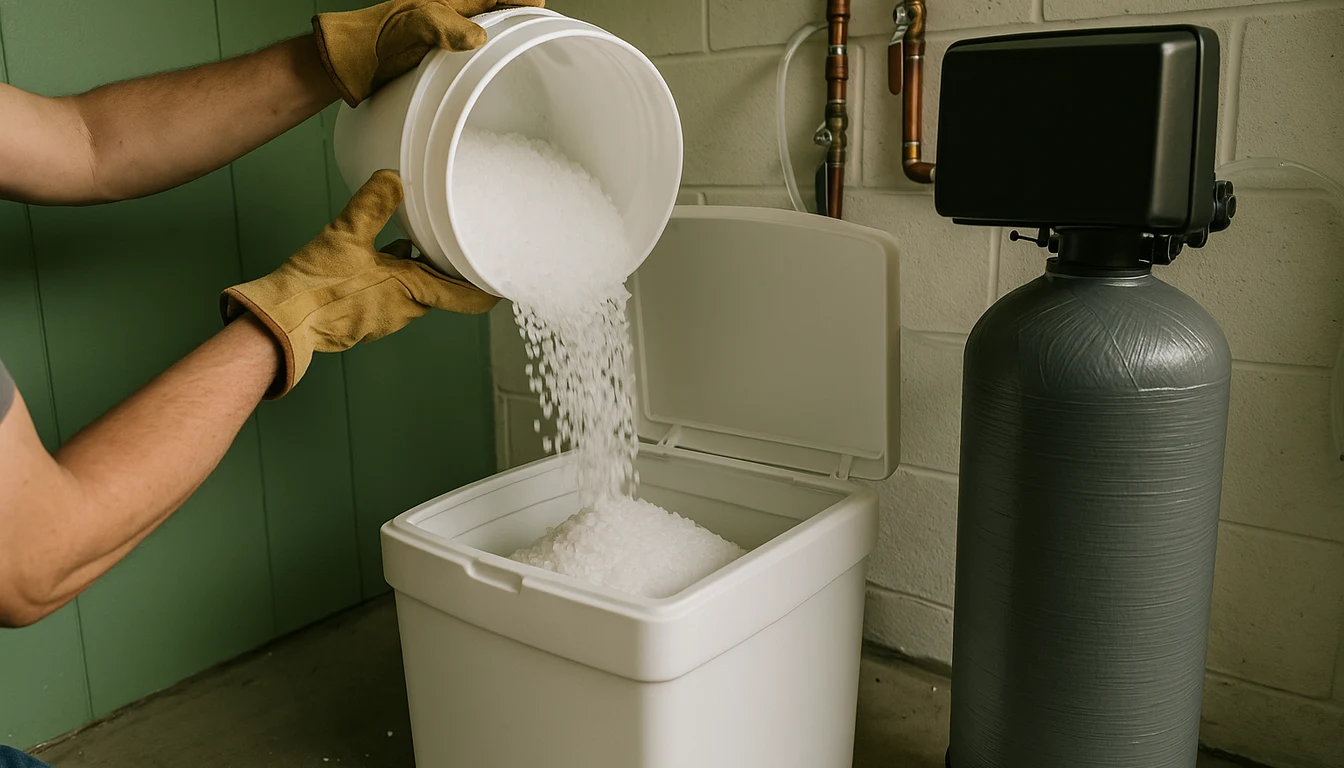
My plumber was in and out in about four hours. He shut off the main, cut into the copper line where it came through the garage wall, added two shutoff valves and a bypass so the softener could be skipped for repairs, and set the resin tank and brine tank on the slab. Then he programmed the valve with our hardness, filled the brine tank, and ran a first regeneration before he left.
Three things added to my bill that were not in the price of the box.
First, the drain. A softener flushes brine during every regeneration, and that water has to go somewhere. Most plumbing codes want an air gap on that line, so dirty water cannot be pulled back into the system. My nearest standpipe was the laundry drain, eleven feet away. That run was part of the $875.
Then the outlet. Most control valves run on a small plug-in transformer. The closest outlet in my garage was on the other wall, and an extension cord was not an option, so I paid an electrician $185 to add one. If your panel is already full, that can grow into a bigger job, and what upgrading an electrical panel costs covers why.
And the permit. My town wanted a plumbing permit for anything that cuts into the main line. It was $65, and the plumber pulled it. Ask before the job starts, because a permit you skip has a way of showing up when you sell.
If you are on septic like we are, ask one more question: where does the brine go? The installer should be able to tell you, and your septic company will want to know when they come out. Some states and towns have rules about softener discharge, and parts of California restrict salt-based softeners entirely. My notes on what septic servicing costs have the pumping side of that.
The water softener jobs that are yours to do
I did not install mine, and I would not cut into a main water line myself. A slow drip there is a flooded garage by morning. But a surprising amount of this job is yours.
Testing and sizing need no pro. I did the strips, mailed the lab sample and ran the math above at the kitchen counter.
Buying the unit yourself is where the money is. My softener plus the plumber’s labor came to $1,624, against $2,300 for the same job turnkey. Check that your plumber is willing to install owner-supplied equipment before you buy. Mine was, and plenty are not.
If your house already has a softener loop with a drain and an outlet nearby, connecting the unit with flexible connectors is a job some handy homeowners do in an afternoon. Check whether your town requires a licensed plumber for it first.
The upkeep is all yours, and it is easy. Keep the brine tank at least a third full. Once or twice a year, push a broom handle down through the salt to break up any crust that forms across the top, called a salt bridge. The softener can run under it for weeks while making no soft water at all. I found one in March when the faucet crust came back, and it was ten minutes with a broom handle.
If you have been scrubbing mineral crust off the faucets in the meantime, my notes on fixing a dripping kitchen faucet have the vinegar trick I used before we had soft water.
Salt, resin and repairs: the cost that keeps coming
You pay the installer once. You buy salt every month for as long as you own the thing.
A 40-pound bag of softener pellets runs about $6 to $10 in 2026. At 14 grains, our house goes through roughly one bag a month, so call it $90 a year. Potassium chloride, the salt-free alternative some people prefer, works in the same machine but costs $25 to $40 a bag, which puts the same year at $300 to $450.
The resin inside the tank usually lasts 10 to 15 years on city water. Iron and chlorine can shorten that. Replacing the resin runs about $250 to $600, and a control valve repair runs $150 to $450. If you would rather not own the thing at all, rentals run $25 to $60 a month, which is fine for a year or two and a bad deal over ten.
One thing I noticed that I cannot put a number on yet: the sediment I flushed from our water heater the fall before the softener went in was white and crunchy. This year it came out close to clear. If your water heater is already near the end, what a water heater replacement costs is worth reading before you buy a softener to protect it. And if you are replacing kitchen fixtures in the same stretch, my garbage disposal replacement notes cover the plumbing under the sink.
Water softener installation cost by house setup
The same softener costs very different amounts to install depending on where your pipes run. Find your house in this table before you read any quote.
| House setup | Installed total, 2026 | What drives the cost | Watch for |
|---|---|---|---|
| Existing softener loop, drain and outlet nearby | $600 – $1,800 | Mostly the unit itself | Old loop valves that no longer shut fully |
| Loop, but no drain within reach | $900 – $2,200 | Running a drain line with an air gap | A drain that has to cross a finished room |
| No loop, main line in garage or basement | $1,200 – $3,000 | Cutting in, shutoffs, bypass, drain | Permit and a missing outlet |
| Slab house, main line in a wall or outside | $1,800 – $4,000 | Rerouting pipe or an outdoor-rated unit | Freeze protection in cold climates |
| Well water with high iron | $1,500 – $4,000 | Larger unit or an iron filter first | A lab test before any purchase |
| Dealer-sold system with financing | $3,000 – $6,500+ | Brand, warranty, sales commission | Total cost of the monthly payments |
What blows the water softener budget
- Letting the demo set the price. A colored drop tells you the water is hard, not how hard. A $45 lab test or your utility report gives you the number every quote should be based on.
- Buying capacity you do not need. Do the people x 75 gallons x grains math yourself. An oversized unit costs more up front and does nothing extra for a small household.
- Forgetting the drain and the outlet. Measure from the main line to the nearest drain and outlet before you shop. My eleven-foot drain run was a big part of the plumber’s $875, the outlet was another $185, and neither was on the box.
Frequently Asked Questions
How much does water softener installation cost?
For most houses, a salt-based softener installed by a plumber lands around $1,200 to $3,000 in 2026. The unit runs about $400 to $1,500, and installation runs $200 on an existing loop to $1,500 when the plumber has to cut into the main line and add a drain. Dealer-sold systems commonly run $3,000 to $6,500 or more. These are estimates that shift with region and pipe layout.
Do I really need a water softener?
Test first. The USGS classifies water over 180 mg/L, about 10.5 grains per gallon, as very hard, and 121 to 180 mg/L as hard. If you land there and you are scrubbing scale off the faucets every week, a softener usually earns its keep. If your water tests soft or moderately hard, you may not need one at all. The USGS also notes hardness is not a health concern.
Can I install a water softener myself?
Sometimes. If your house already has a softener loop with a drain and an outlet nearby, many homeowners connect the unit themselves in an afternoon. If the plumber has to cut into the main water line, add shutoffs and run a drain with an air gap, that is a job for a licensed plumber, and many towns require a permit for it.
All prices here are 2026 estimates and vary by region, local labor rates, pipe layout, water chemistry, unit size and local permit rules. Tessa is a hands-on homeowner who has hired this work and compared the quotes, not a licensed plumber or water treatment specialist. Nothing here is a test of your water. Get your own water tested, and have a licensed plumber confirm what your house needs before you buy. Use these ranges to ask sharper questions, not as a quote.
Free DIY Project Cost Estimator
The spreadsheet I use to price out a project before I start, so a weekend job never blows the budget. Join the newsletter and I’ll send it over.
No spam, ever. Unsubscribe anytime. — Tessa
Keep reading — more on Plumbing Costs
Garbage Disposal Replacement: The Job, the Cost, and When to Call
I found it with my sock. I stepped into the cabinet under the kitchen sink to…
Read article →
Septic Servicing Cost in 2026: What Pumping and Inspection Run Before the Ground Freezes
The man who sold us this house left exactly one useful thing behind: a napkin in…
Read article →
How Much Does a Water Heater Replacement Cost? (DIY vs. Hire)
Water heater replacement cost in 2026 runs $900 to $3,500 for a tank. Real prices by…
Read article →