
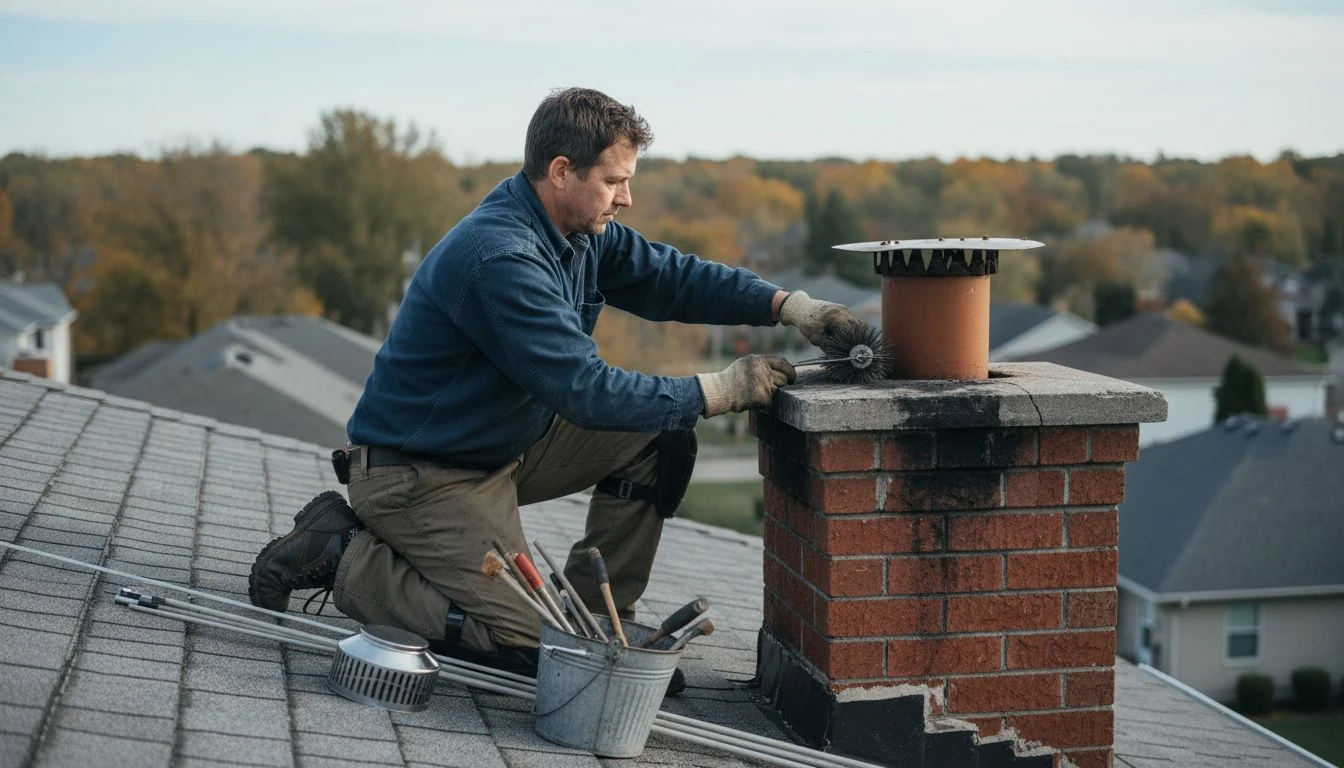
The second year, the same sweep handed me an invoice for $180 and I assumed she had made a mistake. The year before, the visit had been $425. Same chimney, same woman, same ladder leaning on the same gutter.
She had not made a mistake. There was almost nothing in the flue to remove.
Chimney sweep cost in 2026 runs about $150 to $400 for a standard cleaning of one open fireplace flue, $250 to $600 for a wood stove or insert that has to be pulled out, and $500 to $1,200 when there is hardened glaze in there instead of loose soot. The first sweep of a neglected chimney is almost always the expensive one. Every sweep after that is maintenance pricing.
Below is what each appliance costs to clean, what a real sweep includes, the creosote problem that turns a $200 visit into a four figure one, and the month I now book in.
I am a homeowner with a fixer-upper and a folder of invoices, not a certified chimney sweep. Anything involving a liner, a flue repair or a gas appliance belongs to someone who is.
Jump to what you need:
- Chimney sweep cost in 2026
- Cost by what you burn
- What a real sweep includes
- The creosote stage that changes the price
- How often it needs doing
- The month nobody books
- Sweeping it yourself
- Cost by appliance and flue type
- Frequently Asked Questions
Chimney sweep cost in 2026, and why the first one costs the most
Nobody publishes a national price sheet for this. The numbers below come from my own two invoices, the price lists three local companies emailed me when I was collecting quotes, and what four friends in three states paid in the last two seasons.
A standard sweep of a single open masonry fireplace flue lands at $150 to $400. Most of the quotes I have seen cluster around $225 to $325, and a lot of companies fold a basic visual inspection into that price rather than billing it separately.
Then there is the first-visit premium. A chimney that has not been touched in years takes longer, makes more mess, and sometimes needs a second set of hands. Mine had six years of soot in it and a bird nest on the smoke shelf, and that visit ran $425 with a camera scan included. The maintenance visit the following September was $180 and took forty minutes.
That gap is the single most useful thing I know about this job. If you are looking at a number that feels high, ask when the flue was last cleaned. If the answer is “no idea, we bought the house in March,” the number is probably fair. If you swept it last year and someone quotes $500, something else is going on.
My line: I will pay a first-visit premium once. I will not pay it twice on the same chimney.
Chimney sweep cost by what you actually burn
The flue is not the whole job. What sits at the bottom of it changes the labor a lot, and this is where quotes stop being comparable.
- Open masonry fireplace, one flue: $150 to $400. The baseline everything else gets measured against.
- Prefabricated or factory-built fireplace: $150 to $350. Usually faster, and the metal chimney sections are easier to brush than old clay tile.
- Wood stove or fireplace insert: $250 to $600. Many inserts have to be slid out to reach the flue connection, which adds $100 to $300 in labor by itself.
- Pellet stove: $175 to $400. Different work entirely. Vent pipe, exhaust blower, ash traps, and gaskets, more vacuum than brush.
- Gas fireplace or gas logs service: $100 to $250. No creosote, but the flue still collects nests and debris, and the burner and pilot want a look.
- Furnace, boiler or water heater flue: $100 to $250 when it is done on the same visit as another flue. More if it is the only reason someone drives out.
- Second flue on the same trip: add $75 to $150 rather than paying a second full service call.
- Animal nest removal: $75 to $300 depending on what is up there and whether it is still living in your chimney.
- Dryer vent cleaning, added on: $100 to $200. Worth bundling if the crew is already at the house with the vacuum out.
Two more line items show up often enough to plan for. A steep roof or a flue that can only be reached from above adds setup time and sometimes a second technician, and rural addresses pick up a $25 to $75 travel charge that should be on the estimate before anyone drives out.
If the visit turns into cap or crown work, that is a separate quote with separate parts, and mine came to $605 for both. Repairs do not belong inside a sweep price, and a company that blurs that line is one to watch.
What a real chimney sweep includes, and what it does not
I watched the whole thing the first year because I wanted to know what $425 bought.
She put drop cloths over the hearth and the floor in front of it, then sealed a vacuum with a fine dust filter to the fireplace opening and left it running the entire time, which is what keeps your living room from turning gray. Brushes on rods went up the flue. She scraped the smoke chamber and the shelf above the damper, worked the damper until it swung freely, and pulled the debris out through the cleanout door at the base.
Good work leaves no black footprints. My sweep put shoe covers on at the door and took them off at the door, and there was not a speck on the rug when she left.
What is not in a standard sweep: liner repairs, relining, crown sealing, cap installation, masonry work, flashing at the roofline, and anything structural. If your chimney meets the roof badly, that leak is a roofing problem, and our guide to roof repair costs covers it better than any sweep’s invoice will.
Ask for a written report at the end, with photos. Mine came by email that evening, four pictures and a paragraph. That report is what you hand the next company if you ever want a second opinion on a repair, and it is the difference between a professional and a guy with a brush.
One more thing to ask before booking: is the technician certified. The Chimney Safety Institute of America runs a homeowner resources page with a directory of certified pros, and it takes about ninety seconds to look up the name of the person who is coming to your house. I did it the second time. I should have done it the first.
The creosote stage that changes the chimney sweep price
Creosote is what wood smoke leaves behind when it cools on the way up, and it comes in roughly three forms. Sweeps talk about them constantly, and knowing the vocabulary keeps you from being upsold.
- Light, flaky soot that brushes off. This is the normal, cheap outcome, and it is what a maintained chimney looks like.
- Crunchy black flakes, sometimes shiny at the edges. Still brushable, takes longer, may push the visit toward the top of the range.
- Hardened glaze, like tar or dried paint fused to the flue wall. Brushes do not touch it. This is the expensive one.
Stage three glaze usually needs a chemical treatment applied over one or more visits, or a rotary tool with chains that grinds it off, and that work commonly runs $500 to $1,200 on top of a normal sweep. My brother in law paid $640 for two treatments on a wood stove flue, and the sweep told him the cause outright: he had been burning oak he split the previous spring, which is not the same thing as seasoned oak.
The price of your next cleaning is mostly decided by what you burn this winter. The EPA’s wood burning guidance is blunt about it: wood burns best at a moisture content of less than 20 percent, and properly seasoned wood is darker, weighs less, and sounds hollow when you knock two pieces together. A $25 moisture meter is the cheapest chimney maintenance you will ever buy.
Smoldering fires with the air choked down produce far more of this than a hot, bright fire does, and so does burning unsplit rounds or construction scrap. I learned it the winter I bought a porch full of wet firewood that hissed, smoked, and gave me almost no heat for my money.
How often a chimney needs sweeping
Annual inspection and annual sweep are two different recommendations, and they get mashed together in a lot of marketing.
The inspection is the firm one. CSIA follows the NFPA 211 standard, which says chimneys, fireplaces and vents shall be inspected at least once a year for soundness, freedom from deposits and correct clearances. The U.S. Fire Administration gives homeowners the same advice in plainer words on its heating fire safety page: have heating equipment and chimneys cleaned and inspected each year by a professional. That page also carries the number that keeps me honest about this, an estimated 32,200 home heating fires in a year, causing roughly 190 deaths, 625 injuries and $442 million in property loss.
The sweep is conditional. CSIA’s own rule is that masonry fireplaces should be swept at one eighth of an inch of sooty buildup, and sooner if there is any glaze present. A quarter is about a tenth of an inch thick, which gives you a sense of how little that is.
In practice, for a wood burner, one sweep per cord to cord and a half of wood is the rhythm most sweeps described to me. Burn two or three cords a winter and you may need two cleanings. Light six fires a year at Christmas and you may go two or three years between sweeps while still getting the annual look.
Gas does not get a pass, either. Gas flues collect nests and debris, and a furnace venting through an old chimney flue has its own venting issues worth checking. I schedule mine the same week as the heating tune up, and what furnace repairs cost covers that side of the bill. The chimney sits on the same September list as the gutters and the outdoor spigots in my checklist for winterizing a house.
When to book, and the month nobody thinks about
Everybody calls in October. Calendars fill three and four weeks out by the middle of the month, and nothing gets discounted.
September is the obvious gap, and it is the one I use. The cheap window is spring. April and May are dead weeks for chimney companies, two of the three I called offered off season pricing then, and there is a practical reason to go early that has nothing to do with money.
Soot left sitting in a flue all summer smells. Humid air moving down a chimney picks up that old ashtray odor and pushes it into the living room, usually in July, usually right after you have run the air conditioning for a week. Leftover deposits are also acidic, and sitting against mortar and a metal damper for six months does them no favors. Sweeping in spring gets the mess out before any of that happens.
If you are staring down October right now and the calendars are full, book the appointment anyway and do not light anything until it happens. That is the part I got right in my first year, mostly by accident.
Sweeping it yourself: what it costs, and when I would not
You can buy a poly brush and fiberglass rod kit for $40 to $150, and a shop vacuum with a fine dust filter for another $60 to $120. For the right chimney, this is a reasonable Saturday. I have done the stove pipe on a friend’s cabin.
Reasonable looks like: a straight flue you can see all the way up, light flaky soot, a single story roof you are comfortable on, or a setup you can brush from below through the firebox. Seal the fireplace opening with plastic and tape around the vacuum hose, wear a respirator and eye protection, and expect to be filthy.
I call someone else when there is any glaze at all, when I cannot see up the flue, when the roof is steep or tall, on a second story insert, and on anything that burns oil or gas. I also call in any year I want the inspection on paper. You are paying a sweep for the eyes more than the brushing, and for knowing what a cracked tile looks like on a camera screen.
The other thing you give up is the written report, which is what a buyer’s inspector or an insurance adjuster will ask for. Mine asked.
Take this to every chimney sweep quote. Is the price per flue or per visit, and how many flues does my house have. Is a basic inspection included, or is it a separate line. Is the technician certified, and what is the certification number. What is the surcharge if the insert or stove has to be pulled out. What happens to the price if you find glaze, and is that a separate estimate I approve before you start. Do I get a written report with photos. Is there a travel charge for my address. Is there off season pricing. Get the total in writing before anyone unloads a ladder, and get a second estimate on any repair over $500.
The one thing I would not do is hire on price alone from a flyer. My first call as a homeowner was to an $89 special that ended with a $4,800 liner quote and a request for cash, and the whole story is in our guide to chimney inspection cost by level. Putting two written bids side by side is covered in how to tell if a contractor quote is fair.
Chimney sweep cost by appliance and flue type in 2026
Start from the row that matches your setup. The right column is the thing that moves your number most, and it is usually the thing a quote does not mention.
| What you have | Typical 2026 sweep | What is usually included | What pushes it up |
|---|---|---|---|
| Open masonry fireplace, one flue | $150 – $400 | Sweep, basic visual check, cleanup | Years of buildup, tall or steep roof |
| Prefab or factory-built fireplace | $150 – $350 | Sweep of metal chimney sections | Damaged panels found, cap access |
| Wood stove or fireplace insert | $250 – $600 | Sweep, stove pipe, firebox vacuum | Pulling the insert, $100 – $300 |
| Pellet stove | $175 – $400 | Vent pipe, ash traps, blower, gaskets | Skipped seasons, worn gaskets |
| Gas fireplace or gas logs | $100 – $250 | Flue check, burner and pilot service | Nest removal, venting problems |
| Furnace or boiler flue | $100 – $250 | Flue cleaning with another service | Being the only flue on the trip |
| Second flue, same visit | $75 – $150 added | Sweep of the additional flue | Separate roof access |
| Stage three glaze treatment | $500 – $1,200 | Chemical or rotary removal, repeat visits | Unseasoned wood, smoldering fires |
| Animal nest removal | $75 – $300 | Debris removal from flue and shelf | Live animals, no cap installed |
What blows the chimney sweep budget
- Burning wood that is not seasoned. Wet wood is what builds the glaze that turns a $225 sweep into a $640 treatment. A moisture meter costs $25 and pays for itself the first winter.
- Skipping the cap. No cap means rain down the flue, nests on the smoke shelf, and a nest removal charge stapled to every cleaning. A cap runs $200 to $500 installed and stops all three.
- Letting it go five years. The first sweep of a neglected chimney costs roughly double the maintenance visit, and the deposits that sit there in the meantime are doing quiet damage to the mortar and the damper.
If the chimney turns into part of a bigger list this year, our roundup of home renovation costs puts it next to everything else asking for the same money, and gutter cleaning cost is the other fall job most people book late.
A new boiler can change what the chimney needs, from a stainless liner to no chimney at all with a side-wall vent. I covered that in my guide to replacing a boiler.
Frequently Asked Questions
How much does a chimney sweep cost in 2026?
A standard cleaning of one open fireplace flue runs about $150 to $400, with most quotes between $225 and $325. A wood stove or insert that has to be pulled runs $250 to $600, a pellet stove $175 to $400, and a gas fireplace service $100 to $250. Hardened glaze adds $500 to $1,200. These are estimates, and your region, roof access and flue condition move them.
Does a chimney need to be swept every year?
It needs to be inspected every year. NFPA 211, the standard CSIA follows, calls for an annual inspection for soundness, deposits and clearances. Sweeping is based on what the inspection finds, at one eighth of an inch of sooty buildup or any glaze. A heavy wood burner may need two cleanings a season, while someone who lights six fires a year may go two or three years between sweeps.
Is it cheaper to clean a chimney yourself?
Yes, on paper. A rod and brush kit costs $40 to $150 and can be reused for years. It makes sense for a straight, accessible flue with light flaky soot, especially on a stove pipe. It does not make sense with any glaze, a flue you cannot see up, a steep roof, or a gas appliance, and it skips the written inspection report that a certified sweep leaves behind.
All prices here are 2026 estimates gathered from real invoices and local price sheets, and they vary by region, appliance, roof access and flue condition. Tessa is a hands-on homeowner who has paid these bills and kept the paperwork, not a certified chimney sweep or a licensed contractor. Nothing here is instruction for liner, flue or gas appliance work. Use these ranges to ask sharper questions and read your own quotes, not as a price for your house.
Free DIY Project Cost Estimator
The spreadsheet I use to price out a project before I start, so a weekend job never blows the budget. Join the newsletter and I’ll send it over.
No spam, ever. Unsubscribe anytime. — Tessa
Keep reading — more on Remodel & Renovation Costs
Boiler Replacement Cost: Gas, Oil, and Combi Boilers Compared
My friend Marisol called me on a Sunday in October with her coat on inside the…
Read article →
HVAC System Replacement Cost: Furnace, AC, or Both at Once
The tech who told me my air conditioner was done also handed me a second price…
Read article →
Furnace Tune Up Cost: What a Fall Service Includes (and What to Skip)
Three companies left door hangers on my porch the same week in September. One said $79.…
Read article →
Furnace Blower Motor Replacement Cost in 2026: PSC vs ECM
My dad called on a Sunday in January and opened with “the furnace is running but…
Read article →