
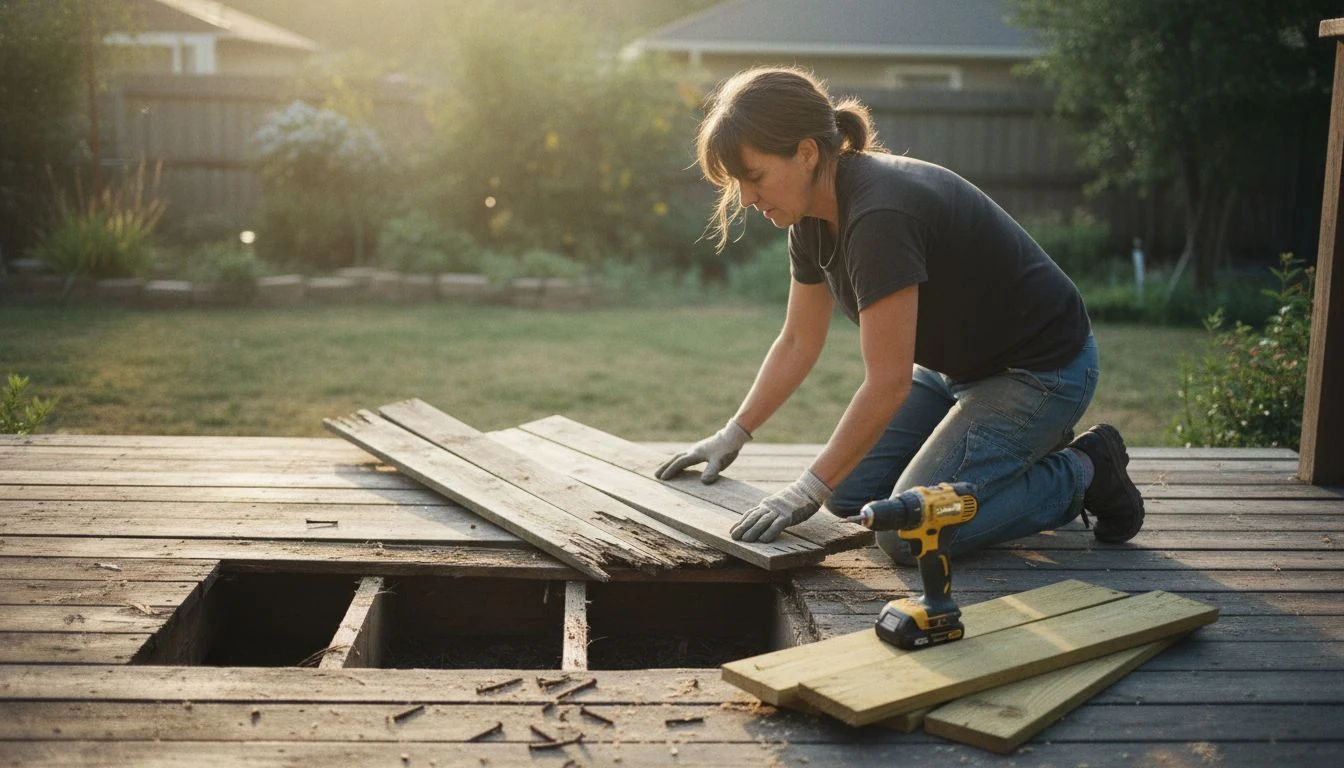
My deck told me it was rotting a full year before I listened. Third summer in this house, I stepped on the second board down from the sliding door and it flexed under my heel like a diving board. I told myself it was springy. It was soft. There is a difference, and it cost me $1,150 to learn it.
Average deck repair cost in 2026 lands between $700 and $3,000, with most homeowners writing a check somewhere near $1,900. Swapping a handful of surface boards can be a $250 Saturday. A rotted ledger board where the deck meets your house can run past $3,000 on its own. That spread is enormous, and it is not random. Your real deck repair cost depends almost entirely on one thing: whether the damage is on top of the frame or inside it.
Jump to what you need:
- What deck repair costs in 2026
- Cost by type of damage
- Repair, resurface, or replace?
- The screwdriver test that decides everything
- What you can fix yourself
- What drives the price up
- FAQ
What does deck repair cost in 2026?
Most deck repairs fall in the $700 to $3,000 band. Priced by area, professional work runs roughly $8 to $25 per square foot depending on how deep the crew has to go, and labor is usually 60 to 70 percent of the bill. That ratio is the opposite of a fence or a floor, where materials carry the cost. On a deck you are mostly paying someone to find the bad wood and get it out.
My deck is 12 by 16, so 192 square feet. I got two quotes. One was $1,850 to replace eleven boards and re-set the stair railing. The other was $9,400 to tear the whole thing down and rebuild it in composite. Both contractors were looking at the same deck. And the second guy was not scamming me. He was answering a different question than the one I asked, which is how a deck repair cost estimate turns into a rebuild estimate without anybody lying to you.
The mistake I made was calling for quotes before I knew what was actually wrong. I got numbers I had no way to judge. Spend twenty minutes underneath your deck with a flashlight first, and you walk into those conversations knowing whether you have a board problem or a frame problem.
Deck repair cost by type of damage
This is the table I wish I had in June. The jobs at the top are afternoons. The jobs at the bottom are the ones holding your deck to your house, and they are why deck repair cost estimates vary so wildly between two people with the same square footage.
| Repair | Installed (2026 est.) | DIY materials | Who should do it |
|---|---|---|---|
| Re-fasten popped nails and screws | $150 to $500 | $25 to $60 | You, easily |
| Replace a few surface boards | $200 to $900 | $8 to $35 per board | You |
| Tighten or re-anchor a wobbly railing | $200 to $1,000 | $60 to $250 | You, if the posts are solid |
| Full railing replacement | $700 to $3,500 | $300 to $1,200 | Pro (it is a code item) |
| Rotted joist, per joist | $500 to $2,000 | $80 to $300 | Pro |
| Post or footing replacement, per post | $400 to $1,500 | $60 to $200 | Pro |
| Stairs and stringers | $400 to $2,500 | $150 to $600 | Pro if structural |
| Ledger board repair and reflashing | $500 to $3,000 | Do not | Pro, always |
| Full resurface, all boards, frame stays | $10 to $25 per sq ft | $6 to $14 per sq ft | Either |
Notice the ledger row. That single component is where deck failures come from, because it is the joint carrying your deck’s weight against the house, and it lives behind flashing where water goes to hide. It is also the one line on this table where I will tell you not to DIY. Everything else on here is negotiable.
Repair, resurface, or replace?
Contractors have a rough rule and it is a good one. If more than about 40 to 50 percent of the structure is compromised, repairing stops making financial sense and you are better off rebuilding. Under that, repair almost always wins, because the frame and footings are the expensive half of any deck and yours are already in the ground and paid for.
There is a middle option most homeowners never get offered, and it saved me thousands: resurfacing. You keep the joists, beams, posts, and footings, and you replace only the deck boards and railing. On a sound frame that runs about $10 to $25 per square foot against $30 to $60 for a full rebuild. Same deck to look at. Roughly a third of the price.
My second contractor quoted a rebuild because I asked “what would you do with it,” which is a question that gets you the biggest number in the room every time. When I went back and asked “is the frame sound enough to resurface,” he said yes without hesitating. If you are past that point and the frame really is finished, then it is worth looking at what it costs to build a deck from scratch so you are comparing a real rebuild number against your repair quote, not a guess.
The screwdriver test that decides everything
You do not need a contractor to tell you which category you are in. You need a flathead screwdriver and about twenty minutes.
Go under the deck with a flashlight and press the screwdriver tip into the wood, hard, in the places water sits: where joists meet the ledger, the tops of posts, the bottom of the stair stringers, anywhere the ground is damp. Sound wood resists. Rotted wood takes the blade like a stick of butter, and once it goes in more than a quarter inch you have found structure that needs replacing, not a board that needs staining. The EPA recommends this same probe test for checking exposed wood for hollow spots when hunting termite damage, and it works identically for rot. Same tool, same tell.
I found four soft spots. Three were surface boards. One was the top of a post, which is what turned my $600 mental estimate into an $1,150 real one. Better to find that in June with a screwdriver than in August with a foot.
One thing worth knowing while you are down there: modern decking is pressure treated with copper-based preservatives like ACQ and copper azole, which the EPA lists as the most widely used wood preservatives for residential use. They resist rot well, but only where the treatment is intact. Every cut end and every screw hole is a door. That is why decks rot from the fasteners and the cuts outward, which is exactly where your screwdriver should go first.
What you can fix yourself, and what you really should not
Board replacement is beginner work, and it is the cheapest way to cut a deck repair cost quote in half. Pull the old board, cut a new one to length, pre-drill, drive two screws per joist. The tools are a circular saw, a drill, and a pry bar. Eleven boards took me most of a Saturday and a sore back, and I am not a carpenter.
Buy your boards a week early and stack them flat where they will live. Lumber shrinks and cups as it dries, and boards that acclimate on your deck fit tighter than boards that came off a hot truck an hour ago. I skipped this the first time and two boards developed a gap by September that I still look at.
Railings, joists, posts, and anything touching the ledger belong to a pro. Those parts are what stop a deck from coming off a house with people standing on it, and railing height and baluster spacing are inspected code items in most jurisdictions. The cuts are not the hard part. The consequences are. Paying $800 to have a railing done right is cheap.
Splitting the job is where you take real money off your deck repair cost, and here is what I actually did: I demoed the bad boards and hauled the debris myself over a weekend, then paid a carpenter for the post and the railing. That single division took the $1,850 quote down to $1,150.
Whatever the split, get it in writing and get three of them. If a bid comes back and you cannot tell whether it is fair, walk it through how to tell if a contractor quote is fair before you sign anything. And if any post or footing is getting dug out, call 811 first so your utilities get marked. It is free and it takes one phone call.
What drives your deck repair cost up
A repair quote is a one-day number. What you actually want to know is what this deck costs you over the next decade, because that is the math that decides whether $1,900 in repairs is smart or whether it is throwing money at a deck that needs replacing in three years anyway.
| Path | Up-front, 192 sq ft (2026 est.) | Buys you roughly | Next spend to expect |
|---|---|---|---|
| Spot repair, sound frame | $700 to $1,900 | 4 to 8 more years | Stain every 2 to 3 yrs, $200 to $500 |
| Resurface in wood | $2,000 to $4,800 | 10 to 15 years | Stain every 2 to 3 yrs, $200 to $500 |
| Resurface in composite | $3,500 to $7,700 | 20 to 25 years | Washing only, near $0 |
| Full rebuild in wood | $5,800 to $11,500 | 15 to 20 years | Stain every 2 to 3 yrs |
| Full rebuild in composite | $7,700 to $15,400 | 25 to 30 years | Washing only, near $0 |
Read the second and third rows against each other. That is the honest decision behind most deck repair cost questions. Composite resurfacing costs about $2,000 more and buys you a decade more deck plus every staining weekend of your life back. I went wood because I had $1,150, not $5,000. That was a budget decision, not the better one, and I will be re-staining in 2028 knowing exactly what I traded.
What blows the deck repair budget
- The rot you find after the first board comes up. Nobody can quote what they cannot see, and the bad wood is under the good wood by definition. Assume a 20 to 30 percent contingency on any deck repair cost estimate, and ask the contractor in advance what the per-joist rate is if they find more. Getting that number before the demo is worth more than haggling over the base bid.
- Railing code you did not know you were triggering. Replace a railing and you usually have to bring the whole thing to current code, which can mean taller posts and tighter baluster spacing than what you had. A $700 railing swap becomes a $2,200 railing rebuild. Ask your building department what applies before you get quotes, not after.
- Paying a crew to do the demolition. Tear-out and hauling is the least skilled and most expensive-by-the-hour part of the job, and it is almost always billed at the same rate as the carpentry. Pulling boards and loading a dumpster yourself is the single easiest chunk of a deck repair to claw back. It is what took $700 off my bill.
Once the repair is done, seal it before the weather gets to the new wood. Fresh boards need to dry out first, then they need protecting, and the timing matters more than the product does. Here is how to stain a deck properly, including how long to wait on new lumber. If the deck is one line item in a bigger year, it helps to see it beside what home renovations cost in 2026 before you commit the season’s budget.
Grab my free Project Cost Estimator. Before a single contractor walks your deck, fill in your square footage, the damage you found with the screwdriver, and how much demo you are willing to do yourself. It is the same one-page sheet that showed me a $1,850 quote and a $1,150 quote were the same job with the weekend work moved to my side of the line.
Soft posts near the ground are sometimes termites rather than rot, and the termite inspection cost breakdown.
Frequently Asked Questions
Is it cheaper to repair or replace a deck?
Repair, in most cases, and by a wide margin. Deck repair cost averages $700 to $3,000 while a full rebuild runs $30 to $60 per square foot, or $5,800 to $15,400 on a typical 192 square foot deck. The tipping point contractors use is roughly 40 to 50 percent structural damage. Below that, repairing keeps the frame and footings you already paid for. Above it, you are pouring money into wood that is going to fail anyway.
How much does it cost to replace a few deck boards?
Expect $200 to $900 installed for a handful of boards, or $10 to $60 per board depending on length and material. Doing it yourself drops that to $8 to $35 per board in lumber. It is one of the friendliest DIY repairs on a deck, needing only a circular saw, a drill, and a pry bar. Buy the boards a week early and let them acclimate flat before you cut.
How do I know if my deck is unsafe?
Probe the wood with a screwdriver where joists meet the house, at the tops of posts, and at the base of the stairs. If the blade sinks in more than a quarter inch, that is rot in structure and not a cosmetic issue. Also push hard on the railing. If it moves at the post, stop using it. Any softness at the ledger board where the deck attaches to the house means calling a professional this week, not this season.
All prices here are 2026 estimates and vary by region, deck size, height, access, and local labor rates. Tessa is a hands-on homeowner, not a licensed contractor; use these ranges to ask sharper questions and always confirm figures and code requirements with local pros and your building department.
Free DIY Project Cost Estimator
The spreadsheet I use to price out a project before I start, so a weekend job never blows the budget. Join the newsletter and I’ll send it over.
No spam, ever. Unsubscribe anytime. — Tessa
Keep reading — more on Exterior & Structural Costs

Gutter Cleaning Cost: What I Paid, and the Month It Stops Being Optional
Gutter cleaning cost in 2026 runs $120 to $425 for most houses. Real quote numbers, what…
Read article →
Foundation Repair Cost in 2026: The Crack That Matters and the One That Does Not
A man in a branded polo put a level against my basement wall, made a face…
Read article →
Roof Repair Cost in 2026: What It Costs by What Actually Broke
The stain showed up on the upstairs hallway ceiling the morning after a March storm, about…
Read article →
Garage Door Spring Replacement Cost in 2026 (and Why I Do Not DIY This One)
It sounded like a rifle going off in the garage at 6:40 on a Tuesday morning.…
Read article →