
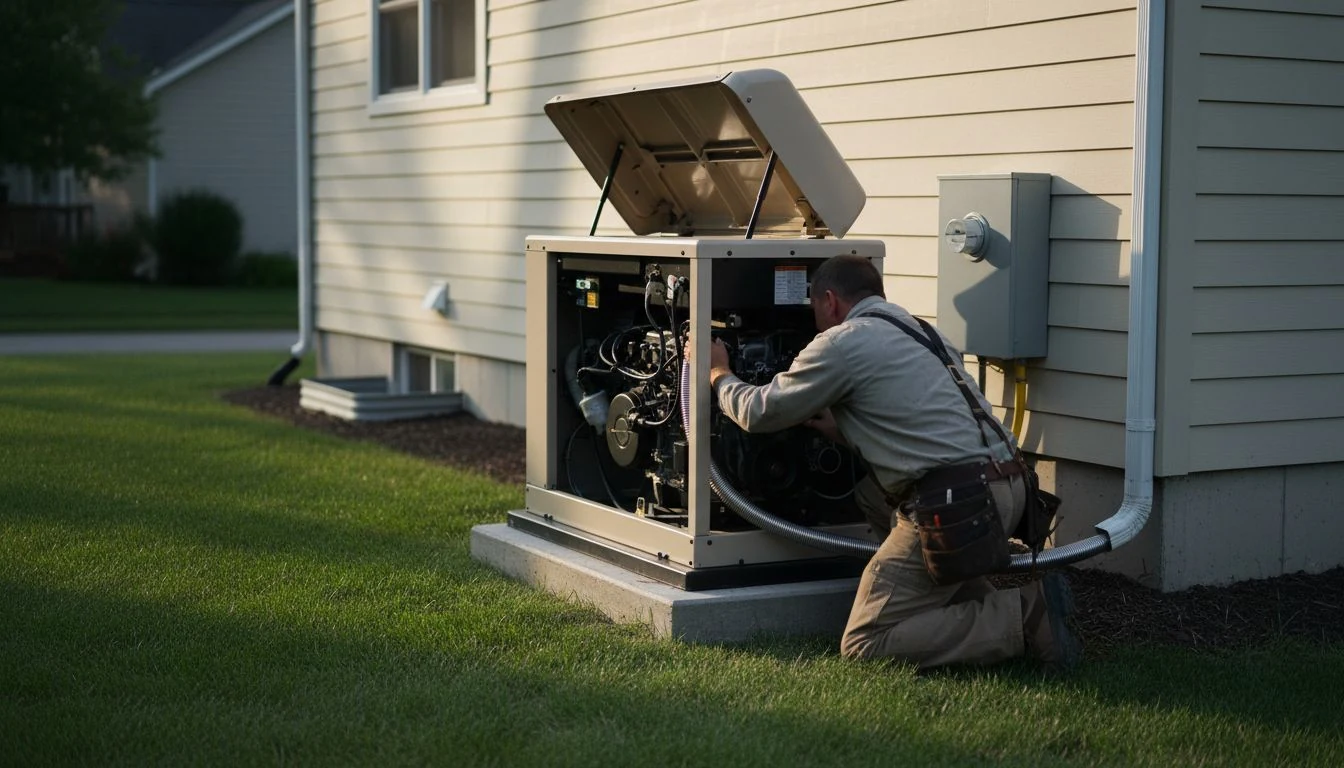
The freezer is what finally did it. Three days without power in February, and I stood in the garage throwing out a whole shelf of food I had bought on sale, which is the most expensive way to save money I have ever found.
In 2026, whole house generator installation cost lands somewhere around $6,000 to $18,000 installed for the air cooled units most houses get, and $15,000 to $35,000 once you move up to a liquid cooled machine. Ours came to $12,870. About $2,250 of that was a gas line the first company never put on paper.
I am a homeowner who reads permits for fun, not a licensed electrician. What follows is our actual invoice line by line, how we picked the size, and the two questions that separated a real quote from a pretty one.
Jump to what you need:
- Whole house generator installation cost in 2026: our invoice
- How many hours of outage you are actually buying out of
- Sizing a whole house generator by what you keep running
- The transfer switch is the part that makes it legal
- Natural gas, propane, and the line nobody quoted
- Portable versus whole house generator installation cost
- What it costs every year after the truck leaves
- Whole house generator installation cost by size
- Frequently Asked Questions
Whole house generator installation cost in 2026: our invoice
Our house is a 2,100 square foot ranch from 1994, natural gas, well water, and a finished basement that stays dry only because a sump pump says so. That last part matters more than the freezer did.
The final bill, in the order it appeared on the paperwork:
- Generator, 22 kW air cooled, on a composite pad: $5,400.
- Automatic transfer switch, whole panel, 200 amp service: $1,150.
- Electrical labor, two days, two people: $2,900.
- Pad set, leveling and gravel base: $480.
- New gas line, 90 feet, plus a meter upgrade: $2,250.
- Electrical and mechanical permits: $365.
- Startup and commissioning by the dealer: $325.
That is $12,870. Two quotes came in under $10,500 and both of them were fiction, because neither one included gas.
The spread on these jobs is wide. Most of it is how far the machine ends up from the gas meter and the panel. A 14 kW unit going next to an existing gas meter with the panel eight feet away on the other side of the wall is a one day job and can land near $7,000. Push the machine to the far side of the house, add a trench, add a propane tank, add a panel that was already full, and you are at $20,000 without anybody padding anything.
How many hours of outage you are actually buying out of
I wish somebody had made me look at this before I signed.
The Energy Information Administration tracks how much power the average American customer loses in a year. In 2024, using the measure that counts storms and major events, the average customer went 662.6 minutes without electricity across about 1.5 interruptions. That is roughly eleven hours. Strip the major event days back out and the same year drops to 131.6 minutes, a bit over two hours.
Put those two numbers side by side and you can see what you are buying. In a normal year you are buying your way out of about two hours of inconvenience. The other nine hours are the storms, and storms do not arrive in even slices. They arrive as one ugly stretch where the whole street is dark for three days and the utility is working somebody else’s street first.
Against the average year, a standby generator is a bad buy. Two hours of darkness does not justify twelve thousand dollars. The case for it lives entirely in the week the street goes down and the sump pump has a job to do. If that week would cost you a flooded basement, a medical device, or the income from a home office, the math works. If it would cost you a dark living room and a phone at 40 percent, buy a good flashlight and keep your money.
Ours was the sump pump. Two of the three outages we have had since install came with rain.
Sizing a whole house generator by what you keep running
All three salespeople opened with the same question, and it was the wrong one. They asked how big our house is. Square footage does not draw amps. The furnace blower and the well pump do, and neither one cares how many bedrooms sit above them.
The better question, and the one the third guy asked, is which circuits have to stay alive. We walked the panel together and wrote them down: furnace blower, sump pump, refrigerator, freezer, well pump, the kitchen counter outlets, the router, and two bedrooms. Then the ones I wanted if it was affordable: the range, the water heater, and one of the two air conditioners.
That list is what sets the size, and the size is what sets most of the price.
The well pump moved our number more than anything else on that list. It has a startup surge several times its running draw, which is why the motors in a house set the size while the lightbulbs barely register. The air conditioner is the greediest thing on the list, so plenty of homes get a load management module instead of a bigger machine. Ours shuts the second air conditioner out while the range is pulling, which cost about $300 and saved us stepping up a whole size.
My mistake here was wanting everything. I started at 26 kW because I liked the idea of the house not knowing the power was out. Dropping to 22 kW with load management saved roughly $1,400 and I have not noticed once.
The transfer switch is the part that makes it legal
The generator is the thing you see. The transfer switch is the thing that matters, and it is the reason this is not a weekend project.
The switch sits between the utility feed and your panel. When the power drops it disconnects your house from the grid, starts the generator, and moves your circuits over. When the utility comes back it does the reverse and shuts the engine down. Ours takes about twelve seconds, which is long enough for the clocks to blink.
The reason this is licensed work, and the reason an inspector shows up afterward, is backfeed. If a generator feeds your panel while the house is still tied to the utility, that power goes back out the service line. A line worker who believes the wire is dead can be killed by your generator. Your own wiring can be destroyed when the utility restores power into a running machine. The interlock and the permit both exist because of that.
I am not going to write connection instructions here, and you should be suspicious of anyone who does. Hire the license. It is on the invoice for a reason.
One practical note. A whole panel switch, the kind we got, costs more than an essential circuits switch but saves you sorting your life into two categories. If your panel is old, tired, or already full, price the switch and the panel together, because upgrading an electrical panel in the same visit is far cheaper than doing it as a separate job six months later.
Natural gas, propane, and the line nobody quoted
Our budget broke on fuel.
A standby generator needs fuel piped to it, and the pipe already running to your furnace is almost certainly not big enough to add a generator on the end. Gas lines are sized for total demand and length. Add a machine that can pull as much as the rest of the house combined, at the far corner of the lot, and the utility has to look at the meter too.
Ours needed 90 feet of new line and a meter upgrade, which came to $2,250. The first two quotes said, in small print, gas connection by others. I read that as boilerplate. It was $2,250 sitting outside the number on the front page.
Propane changes the shape of the cost instead of removing it. If you do not have natural gas at the street you are buying or leasing a tank, and a 500 gallon tank set on a pad is commonly $1,500 to $3,500 before a drop of fuel. The upside is that you own your fuel supply. The downside is that you are watching a gauge during the exact week everyone else is calling for a delivery.
Two questions to ask before you sign anything:
- Is the gas line included in this price, sized for this generator, and who pulls the gas permit.
- Does my meter need to be upgraded, who talks to the utility, and how many weeks does that take.
The second one is a schedule question as much as a money one. Our meter swap took eleven days, and the generator sat on its pad doing nothing the whole time.
Take this to every generator quote. Generator size in kW and whether that number is with or without load management. Is the transfer switch whole panel or essential circuits, and which circuits. Is the gas line included, sized, and permitted, or is it by others. Does the meter need upgrading and who arranges it. Is the pad included and what is it made of. Which permits are included, electrical, gas, mechanical, and who pulls them. Is startup and commissioning included. What is the warranty on the unit, on the labor, and does it require a paid service plan to stay valid. What does the first year of service cost. Send the same sheet to all three companies and make them answer on paper.
Portable versus whole house generator installation cost
I ran a portable for two winters before this and I am not going to pretend it was useless. It was not. It was just a job.
A 7,500 watt portable runs about $700 to $1,600. Have an electrician install a manual transfer switch or a panel interlock and an inlet box, and that is commonly another $500 to $1,500. Call it $2,500 all in for a setup that is legal, permitted, and does not involve cords through a window. That is roughly a fifth of what we spent.
The extra ten thousand dollars bought one thing: the machine starts itself. No trip outside in freezing rain at 2 a.m., and no deciding which two appliances get the cords tonight. It also runs while we are at my sister’s for the weekend, which is the version of an outage that ruins a basement.
The safety rules are the same machine to machine. The federal guidance on running a generator outdoors only, at least 20 feet from windows, doors and attached garages, with working carbon monoxide detectors on every level of the house, applies to a portable on the patio and to a standby on its pad. Same page also gave me the food timeline I now keep on the fridge: a closed refrigerator holds about four hours, a full freezer about 48, and anything that has sat at 40 degrees or higher for two hours goes in the trash.
A standby unit sits outside on its pad from the day it goes in, so nobody is deciding where to set it at 11 p.m. in the rain. That is worth something, and it never shows up on an invoice.
What it costs every year after the truck leaves
No installer quoted me this, and it is real money.
These engines run a self test every week, usually for about ten minutes, and they need servicing like any small engine: oil, oil filter, air filter, spark plugs, valve check on a schedule. Our dealer plan is $329 a year for one visit. Doing the oil and filters myself would run about $90 in parts, and I have done it once. I went back to paying, because our warranty wants documented service and I did not want that argument later.
Fuel is smaller than people expect for natural gas and larger than people expect for propane. The week of last October’s storm our gas bill came in $41 above the same week the year before, which is fine. A propane neighbor burned through most of a tank in the same outage and paid for a delivery at storm week prices.
Budget somewhere around $250 to $500 a year in service, plus a battery every three to four years at $60 to $120. The battery is the one that strands you. A generator with a dead starting battery is a very expensive lawn ornament, and it gives you no warning first.
If you are already putting money into the house before winter, this slots in next to the rest of it. Our winterizing checklist covers the cheaper items that prevent the outage from being a disaster in the first place, and heat pump maintenance matters more than a generator if your heat is electric, because a tuned system draws less when the generator is the only thing feeding it.
Whole house generator installation cost by size
| Generator size | Unit only, 2026 | Typical installed total | What it covers |
|---|---|---|---|
| 10 to 14 kW air cooled | $2,800 – $4,500 | $6,000 – $10,000 | Essential circuits: heat, fridge, sump, a few outlets |
| 18 to 22 kW air cooled | $4,500 – $6,500 | $9,000 – $15,000 | Most of an average house with load management |
| 24 to 26 kW air cooled | $6,000 – $8,500 | $12,000 – $18,000 | Whole house including central air, no juggling |
| 30 to 48 kW liquid cooled | $12,000 – $22,000 | $18,000 – $35,000 | Large homes, shops, well plus two AC systems |
| Automatic transfer switch | Part of install | $600 – $2,500 | Essential circuits at the low end, whole panel high |
| Gas line and meter work | Separate trade | $500 – $3,500 | Distance, sizing, whether the meter is upgraded |
| Propane tank, 250 to 500 gal | Buy or lease | $1,500 – $3,500 | Pad and set, fuel not included |
| Permits and inspection | Municipal | $150 – $700 | Electrical plus gas or mechanical, varies widely |
What blows the whole house generator budget
- A quote that says gas connection by others. That was $2,250 on our job and it was not on the page I was comparing. Two bids are not comparable until both of them include fuel.
- Distance from the meter and the panel. Every foot between the generator, the gas meter and the electrical panel is trench, pipe and copper. Moving the pad 30 feet for looks is a four figure decision.
- A panel that is already full. The transfer switch has to land somewhere. If the service is old or maxed out, the generator job turns into a panel job too, and that is far cheaper discovered at the quote than on install day.
If the bids are coming back far apart and you cannot tell why, that is usually scope, not greed. Our post on whether a contractor quote is fair walks through reading two bids side by side, and what a general contractor costs is worth reading if your install turns into trenching, concrete and two trades on the same week. Anyone weighing this against replacing aging equipment first should look at furnace replacement cost, because a generator that runs a furnace on its last winter is money spent in the wrong order.
Frequently Asked Questions
How much does whole house generator installation cost in 2026?
Most homeowners land between $6,000 and $18,000 installed for an air cooled unit, and $15,000 to $35,000 for liquid cooled. Ours was $12,870 for a 22 kW machine with a whole panel transfer switch, 90 feet of new gas line and a meter upgrade. The generator itself was under half the total. These are estimates, and the gas line plus the distance from your panel move them more than the brand on the box.
Can I install a whole house generator myself?
No, and the transfer switch is why. Connecting a generator to your panel without proper isolation can send power back out the utility line and kill a line worker who thinks that wire is dead. It also needs a gas or propane connection and an inspection. Setting the pad and doing the site prep is homeowner work if you want to save labor. The electrical and the fuel are licensed trades in every jurisdiction I have seen.
What size whole house generator do I need?
Start from the circuits you refuse to lose, not your square footage. Motors decide it: well pump, sump pump, furnace blower, air conditioning. A 22 kW unit with a load management module covers most average homes and costs less than jumping to the next size. Have the installer do a load calculation at your panel and put the resulting kW number in the written quote.
All prices here are 2026 estimates and vary by region, service size, fuel type, trenching distance and local permit rules. Tessa is a hands-on homeowner who paid this invoice and kept the paperwork, not a licensed electrician, plumber or gas fitter. Nothing here is installation instruction. Use these ranges to ask sharper questions and to read your own quotes, not as a price for your house.
Free DIY Project Cost Estimator
The spreadsheet I use to price out a project before I start, so a weekend job never blows the budget. Join the newsletter and I’ll send it over.
No spam, ever. Unsubscribe anytime. — Tessa
Keep reading — more on Remodel & Renovation Costs
Boiler Replacement Cost: Gas, Oil, and Combi Boilers Compared
My friend Marisol called me on a Sunday in October with her coat on inside the…
Read article →
HVAC System Replacement Cost: Furnace, AC, or Both at Once
The tech who told me my air conditioner was done also handed me a second price…
Read article →
Furnace Tune Up Cost: What a Fall Service Includes (and What to Skip)
Three companies left door hangers on my porch the same week in September. One said $79.…
Read article →
Furnace Blower Motor Replacement Cost in 2026: PSC vs ECM
My dad called on a Sunday in January and opened with “the furnace is running but…
Read article →