
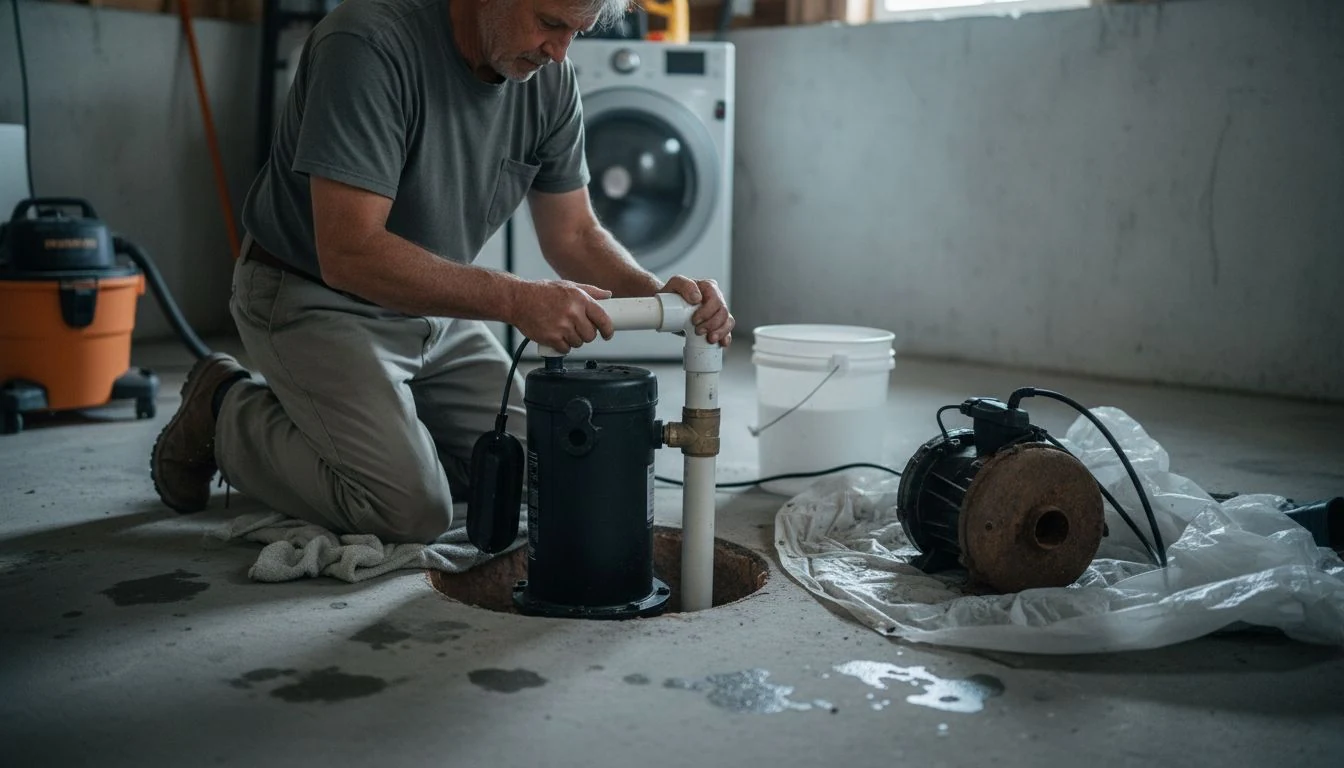
The alarm went off at 2:40 in the morning during the second night of a March rainstorm. It is a small plastic box plugged in next to the pit, and it makes a sound like a smoke detector that is angry at you personally. I went down the basement stairs in socks, which was a mistake, because the floor by the laundry sink was already wet. By sunrise I knew more about sump pump replacement cost than I ever wanted to.
The pump was running. It just was not moving any water. The float had drifted sideways and wedged itself against the wall of the pit, so the motor thought its job was done while the water kept climbing. I held the float up with a broom handle for forty minutes until the pit drained, then sat on the dryer and started pricing pumps on my phone.
The short answer I wish I had found that night: in 2026, replacing a sump pump that already has a pit and a discharge line usually costs about $600 to $1,500 installed, and most homeowners land between $700 and $1,200. The pump itself is often only $150 to $450 of that. Adding a battery backup runs $500 to $1,500 more. And if your house has no pit at all, a new sump pump installation is a different job, closer to $1,500 to $4,500.
My three quotes were $1,650, $725 and $1,090. I paid the middle one, the $1,090, and I will walk through why the cheapest bid would have left me with the same problem and why the most expensive one was mostly the word “emergency.”
I am a homeowner with a damp basement and a folder of receipts, not a licensed plumber. This is what I paid, what I learned, and what I would ask the next time the alarm goes off.
Jump to what you need:
- Sump pump replacement cost in 2026
- Signs your sump pump is about to fail
- Pedestal vs submersible
- Battery and water-powered backups
- Sump pump installation cost with no pit
- Swapping the pump yourself
- Cost table by job
- Frequently Asked Questions
Sump pump replacement cost in 2026, and where the money goes
A replacement quote has four pieces, and it helps to see them separately because contractors like to bundle them into one number.
The pump. A decent 1/3 horsepower submersible pump with a cast iron body and a mechanical float runs about $150 to $350 at a supply house or big box store. A 1/2 horsepower pump for a pit that fills fast is $250 to $450. Pedestal pumps are cheaper, often $80 to $200.
The labor. For a straight swap, where the new pump drops into the same pit and connects to the same pipe, a plumber is usually there for one to three hours. At $75 to $150 an hour plus a trip charge, that lands around $200 to $500.
The small parts. A new check valve ($20 to $60 for the part), a length of PVC, a rubber union so the next swap is easier, and sometimes a new pit lid. Most quotes add $50 to $250 here.
The timing. This one surprised me. Two of my three quotes came in during the storm, and one of them had a $275 after-hours charge baked into the pump price. If your pump fails on a Saturday night in April, you are buying at the worst possible moment.
That is how the same job produced $725 and $1,650 on the same weekend. The $725 quote reused my old check valve, which was cracked. The $1,650 quote included a battery backup system I had not asked for, plus the emergency charge. The $1,090 quote came from a plumber who came out on Monday morning, after I had kept the pit drained over the weekend with a borrowed utility pump, and it included a new check valve, a union, a sealed lid and a pump one size up from what I had.
If a wet basement is part of a bigger water problem, the cost of drying out the space under the house is in our guide to crawl space encapsulation, and it is worth reading before anyone quotes you a full waterproofing system.
Signs your sump pump is about to fail
My pump gave me warnings for most of a year. I did not know what they meant. These are the ones I watch for now, roughly in the order I would worry about them.
It runs when it is not raining. A pump that kicks on every few minutes on a dry day may be sitting on a high water table, or water may be flowing back down the discharge pipe through a bad check valve. Mine was the check valve. You can hear it: the pump shuts off, then there is a gurgle and a rush as the water in the pipe falls back into the pit.
It runs and runs and does not shut off. Either the float is stuck in the up position or the pump is too small for how fast the pit fills. Both burn out a motor quickly.
It never seems to run at all. Pour a five gallon bucket of water into the pit slowly. The float should rise and the pump should start before the water gets near the top. If nothing happens, check that the outlet has power and the GFCI has not tripped before you panic. That little button has fooled a lot of people, including me once.
Grinding, rattling or loud humming. A worn bearing or a bent impeller sounds like gravel in a blender. A hum with no water moving can mean the impeller is jammed.
Rust, and the age of the thing. Most sump pumps last about 7 to 10 years, and heavy-use pits wear them out faster. Mine had a date written on it in marker by the previous owner: 2013. It was twelve years old when it quit, which is about what I should have expected.
If two of these show up at once, I would replace the pump on a dry Tuesday instead of waiting for a wet Saturday. The price difference alone is a few hundred dollars.
Pedestal vs submersible: which sump pump replacement makes sense
There are two kinds of pump, and the pit you have mostly decides for you.
Submersible sump pumps
The whole unit sits at the bottom of the pit, underwater. It is quieter, it fits a sealed lid, and it handles more water. It also costs more, usually $150 to $450 for the pump and $600 to $1,500 installed. This is what most plumbers put in now and what I bought.
The body material matters more than the brand on the box. Cast iron pulls heat away from the motor and tends to outlast the plastic housings. My old pump was plastic and had a hairline crack near the switch when they pulled it out.
Pedestal sump pumps
The motor sits on a post above the pit, and only the intake goes into the water. They are loud, cheaper ($80 to $200 for the pump, $400 to $900 installed), and easy to get at. They make sense in a narrow or shallow pit where a submersible will not fit. In an unfinished basement where noise does not matter, some people prefer them because the motor never sits in water.
Sizing
Horsepower gets all the attention, but the number that matters is how many gallons per hour the pump moves at the height it has to lift the water. A pump rated 3,000 gallons per hour at zero feet might move half that when it has to push water up nine feet and out the rim joist. Ask whoever quotes you what the lift is and what the pump moves at that lift. The plumber I hired measured mine at about 10 feet and went from 1/3 to 1/2 horsepower because the old pump had been running nearly nonstop in storms.
Battery backup sump pump cost, and the water-powered option
A sump pump tends to quit at the worst hour, because storms knock out power and heavy rain is when the pump works hardest. The federal preparedness site Ready.gov’s flood guidance lists a sump pump with a battery as one of the ways to protect your property before a flood, right next to installing check valves.
Battery backup. A second pump sits in the pit a little higher than the main one and runs off a deep-cycle battery when the main pump fails or the power goes out. Installed, most quotes land between $500 and $1,500, including the battery. The battery is a maintenance item: expect to replace it every three to five years, often $150 to $300.
I did not buy the backup that weekend. I added it three months later for about $420 in parts (the backup pump, a marine battery, a battery box and a second check valve) and an afternoon of my time. That made the $1,650 “emergency package” look even worse in hindsight.
Water-powered backup. This uses the pressure of your municipal water supply to pull water out of the pit, no electricity needed. It keeps going as long as the city water is on, and no battery can promise that. Installed cost is usually $400 to $1,200. The catches: it does not work on a private well, it uses a lot of city water while it runs, and many towns require a backflow preventer on the connection, which can add a few hundred dollars and a permit.
If outages are common where you live and you are already pricing whole-house power, our guide to whole-house generator installation cost covers what it takes to keep the pump and everything else running. For most basements, a battery backup is the cheaper place to start.
Sump pump installation cost when there is no pit
Everything above assumes you already have a pit and a pipe going outside. If your basement has never had a sump pump, you are paying for a small construction project.
A new pit means cutting and breaking through the concrete floor, digging a hole about two feet across and two to three feet deep, setting a liner, packing gravel around it, running a discharge line through the rim joist or foundation wall, and patching the floor. Most quotes I have seen for that land between $1,500 and $4,500, depending on how hard the floor is to cut and how far the pipe has to run.
If the water is coming in all along the walls, a pit alone may not be enough. An interior drain tile system, a perforated pipe buried in a trench around the edge of the basement floor that carries water to the pit, runs from about $3,000 to well over $12,000. That is the point where you want three written estimates and a very clear answer about why the water is getting in.
Sometimes the answer is outside. Clogged gutters dumping water right against the foundation fill more sump pits than anyone admits. Our guide to gutter cleaning cost is a cheaper first step than a new trench. And if you see cracks in the foundation walls along with the water, read our breakdown of foundation repair cost before you sign anything for the basement.
One more thing a new pit can affect: radon. An open sump pit is a direct path for soil gas into the house. The EPA’s consumer guide to radon reduction covers how sump pits get sealed and sometimes used as part of a mitigation system. If you already have a radon fan, tell whoever touches the pit, and our guide to radon mitigation system cost explains how the two systems share the same hole.
Swapping a sump pump yourself
This is one of the more reasonable plumbing jobs for a homeowner to do, as long as the pit and pipe are already there and the new pump is the same type and similar size. I did not do mine, because I was tired, it was raining, and the old pipe was glued solid. I did the backup pump myself, and I will do the main swap myself next time.
A like-for-like submersible swap looks roughly like this:
- Unplug the pump. Not the switch, the plug. Then unplug the backup if you have one.
- Bail or vacuum out most of the water left in the pit. A wet shop vacuum makes this a ten minute job.
- Cut or unscrew the discharge pipe above the check valve and lift the old pump out. It will be heavier and dirtier than you expect. Have a bucket and a garbage bag ready.
- Clean the bottom of the pit. Mine had two inches of silt and a golf ball.
- Thread the new discharge adapter into the new pump, add a new check valve with the arrow pointing up and away from the pump, and put a rubber union in the line so the next swap is two hose clamps instead of a saw.
- Set the pump level on a flat brick or paver so it is not sucking up silt, and make sure the float can move freely without touching the wall. That is the exact failure that got me out of bed.
- Plug it in and test it with a bucket of water. Watch it run a full cycle and shut off.
Parts for a DIY swap usually run $200 to $500. Give yourself two to three hours the first time.
Where I would pay a pro: a new pit, anything that means cutting concrete or drilling through the foundation, a discharge line that has to be rerouted, and anything electrical. The pump should be on its own outlet, and in most places that outlet needs GFCI protection. If you do not have one within reach of the pit, an electrician usually charges $150 to $400 to add it. Please do not run the pump on an extension cord.
Take this list to every sump pump quote. What is the lift from the pit to the discharge, and how many gallons per hour does this pump move at that lift. Is the pump cast iron or plastic, and what kind of float switch does it use. Is a new check valve included. Will you add a union so the next swap is easy. Is the lid sealed. Does the pump have its own GFCI outlet, and if not, who adds one. Is there any emergency or after-hours charge in this price. Is a battery backup included, and if so, what battery and how many hours of pumping. What is the warranty on the pump and on your labor. Get three estimates in writing, and ask each one to show you where the discharge water ends up outside.
When the estimates are in, lining them up side by side is a skill of its own. Our guide on how to tell if a contractor quote is fair covers the questions that helped me spot the padding in the $1,650 bid.
Sump pump replacement cost by job
Find the job that matches your basement in the left column. These are 2026 ranges from my own quotes, other homeowners’ invoices and shelf prices. The DIY column is parts only.
| Job | DIY parts | Hired, installed | Typical time |
|---|---|---|---|
| Pedestal pump swap, same pit | $100 – $250 | $400 – $900 | 1 – 2 hours |
| Submersible pump swap, same pit | $200 – $500 | $600 – $1,500 | 1 – 3 hours |
| Check valve only | $20 – $60 | $100 – $300 | Under 1 hour |
| Float switch only | $30 – $90 | $150 – $350 | Under 1 hour |
| Battery backup system | $300 – $700 | $500 – $1,500 | 2 – 4 hours |
| Water-powered backup | $150 – $400 | $400 – $1,200 | 2 – 4 hours, plus permit in some towns |
| Dedicated GFCI outlet at the pit | Hire this out | $150 – $400 | 1 – 2 hours |
| New pit and pump, no existing sump | Hire this out | $1,500 – $4,500 | 1 – 2 days |
| Interior drain tile to a new pit | Hire this out | $3,000 – $12,000+ | 2 – 5 days |
What blows the sump pump budget
- Waiting for it to fail in a storm. After-hours and weekend calls added $150 to $300 to two of my three quotes. A twelve-year-old pump that runs all the time is a Tuesday-morning job.
- Replacing the pump but not the check valve. The cheapest bid kept my cracked valve. The water would have kept falling back into the pit, and the new pump would have worn out early doing the same work twice.
- Paying for a basement system when the problem is outside. Before anyone quotes you drain tile, walk the house in the rain. Gutters, downspouts that drain against the wall and soil that slopes toward the foundation are all cheaper to fix than a trench.
If the basement is headed for a bigger project, get the water under control first, then read our guide to the cost to finish a basement. Carpet and drywall do not survive a failed pump, and I have the dryer-side water stain to prove it.
Frequently Asked Questions
How much does it cost to replace a sump pump?
Replacing a sump pump in an existing pit usually costs about $600 to $1,500 installed in 2026, with most homeowners paying $700 to $1,200. The pump is often $150 to $450 of that. A pedestal pump swap is cheaper, around $400 to $900. These are estimates, and region, lift height and emergency timing move them.
How long does a sump pump last?
Most last about 7 to 10 years. Pumps in pits that fill often, or in basements with a high water table, can wear out sooner. If yours is past seven years and running constantly, cycling on dry days or grinding, plan the replacement before the next wet season.
Is a battery backup sump pump worth it?
If your basement has flooded before, or your power goes out in storms, it usually is. A battery backup typically costs $500 to $1,500 installed, or $300 to $700 in parts to add yourself, which is small next to the cost of drying out a finished basement. Plan to replace the battery every three to five years.
All prices here are 2026 estimates gathered from real invoices, written quotes and store prices, and they vary by region, pit depth, lift height, access, local code and timing. Tessa is a hands-on homeowner who has paid these bills and kept the paperwork, not a licensed plumber or electrician. Use these ranges to ask sharper questions and read your own quotes, not as a price for your house, and hire a licensed pro for electrical work and anything that involves cutting concrete.
Free DIY Project Cost Estimator
The spreadsheet I use to price out a project before I start, so a weekend job never blows the budget. Join the newsletter and I’ll send it over.
No spam, ever. Unsubscribe anytime. — Tessa
Keep reading — more on Remodel & Renovation Costs
Boiler Replacement Cost: Gas, Oil, and Combi Boilers Compared
My friend Marisol called me on a Sunday in October with her coat on inside the…
Read article →
HVAC System Replacement Cost: Furnace, AC, or Both at Once
The tech who told me my air conditioner was done also handed me a second price…
Read article →
Furnace Tune Up Cost: What a Fall Service Includes (and What to Skip)
Three companies left door hangers on my porch the same week in September. One said $79.…
Read article →
Furnace Blower Motor Replacement Cost in 2026: PSC vs ECM
My dad called on a Sunday in January and opened with “the furnace is running but…
Read article →