
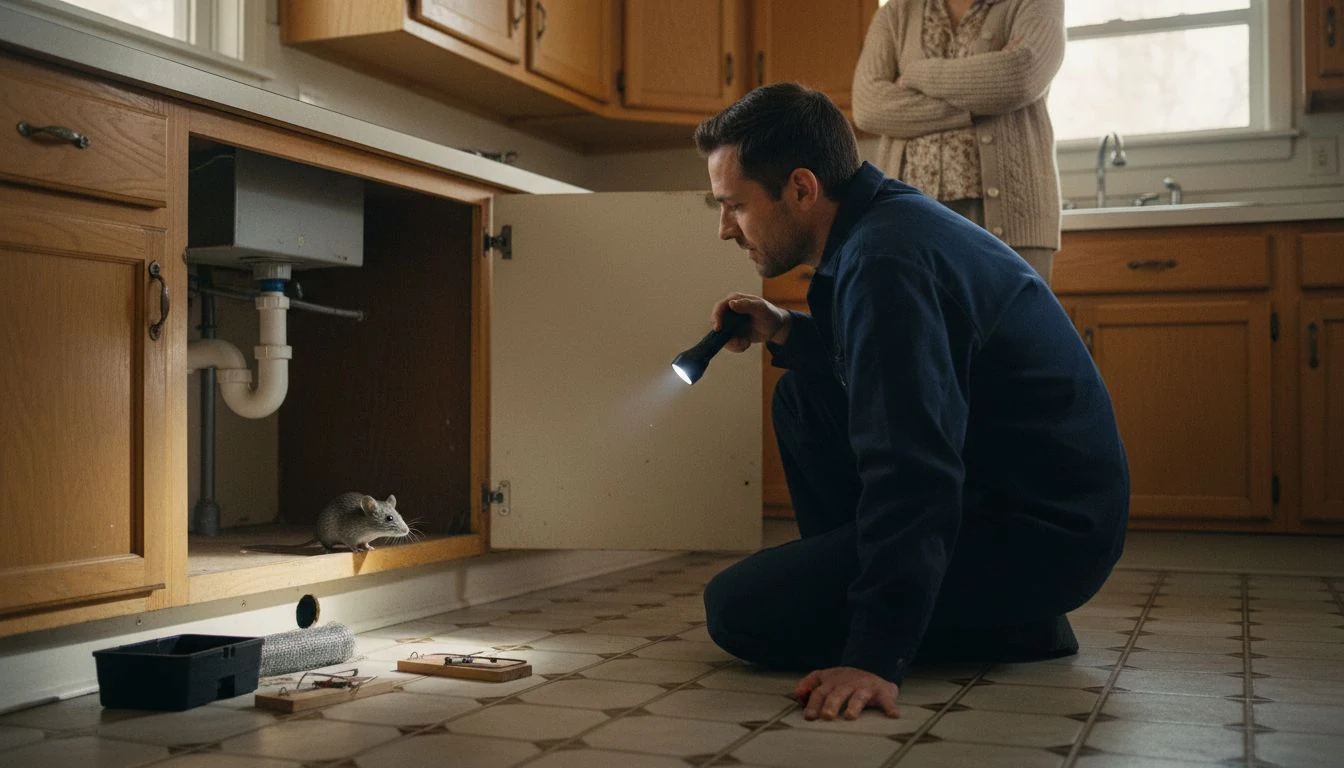
The first clue was the oatmeal. I pulled the canister box out of the pantry one Sunday in October and the bottom corner was chewed into lace. Then I opened the utensil drawer and found what looked like a sprinkle of black rice behind the spatulas. I closed the drawer, stood there for a second, and said a word my mother would not approve of.
Mice. In my kitchen, two weeks after the first cold night, and I had no idea what a mouse exterminator cost.
So I did what I always do before I spend real money: I tried the cheap fix first, got it wrong, and then called three companies for written quotes on the mouse exterminator cost in 2026. The short answer is about $150 to $600 for a one-time trapping service on a typical house, and $300 to $1,500 if you add exclusion, which is the pro sealing up the holes the mice are using. Quarterly plans run about $40 to $70 a month, and they are the part of every quote you should read twice.
Below are all three of my quotes, what the first visit includes, the jobs I did myself for about $45, and the one job I paid a pro to do because I could not find the hole on my own.
Jump to what you need:
- Mouse exterminator cost in 2026
- How I knew it was mice (and my $14 mistake)
- What a mouse exterminator does on the first visit
- The three quotes I got
- When DIY traps are enough
- Sealing them out is the part that ends it
- Mouse exterminator cost: DIY vs pro table
- Frequently Asked Questions
Mouse exterminator cost in 2026
Pest companies price mice in three different ways, and the trick is that a lot of quotes blend them together so you can’t compare one to another.
The one-time service is the simplest. The tech inspects, sets traps or tamper-resistant bait stations, and comes back one to three times to check them. Most of the quotes I saw or heard about from neighbors landed between $150 and $600. A small ranch house with mice only in the kitchen sits at the low end. A two-story with an attic full of droppings sits at the top.
Exclusion is the second kind, and the one that fixes things: finding every gap a mouse can squeeze through and closing it with steel wool, copper mesh, metal flashing, sealant or door sweeps. Typical range: $300 to $1,500. Old houses with stone foundations or lots of plumbing penetrations can go higher. Exclusion is often sold with a warranty on the sealed points, usually 6 to 12 months.
The third is the recurring plan, with quarterly or monthly visits for general pests, with rodents included or added on. These usually start with an initial fee of $100 to $250, then $40 to $70 a month, often on a 12-month agreement.
Then there’s the cleanup the companies rarely bring up until they’re standing in your attic. If mice have been nesting in insulation for a while, removing and replacing the contaminated stuff is its own job, often $1,000 to $3,000 or more depending on the size of the attic. Our attic insulation cost guide has the per-square-foot numbers for putting new insulation back.
All of these are estimates. They vary a lot by region, by how bad the problem is, and by how hard your house is to crawl around in.
How I knew it was mice (and my $14 mistake)
You might never see one. The EPA’s page on how to identify and prevent rodent infestations says as much, and lists what to look for instead: droppings around food packages, in drawers and under the sink, shredded paper or fabric used as nesting, chew marks on packaging, holes chewed through walls or floors, and stale smells from hidden spots.
I had three of the six. Droppings in the drawer, the oatmeal box, and once I started looking, a little pile of shredded paper towel behind the dishwasher kick plate.
Then I wasted money. I’d read online that mice hate peppermint, so I bought a $14 pack of peppermint oil sachets and tucked them into the pantry and the drawer. For two days the kitchen smelled like a candy cane factory. On day three there were fresh droppings right next to a sachet. Maybe it works in somebody’s house. In mine it did nothing, and it cost me a week while the mice kept going.
Mouse droppings are also not something to sweep up dry. Breathing dust from rodent waste is one of the ways rodent-borne disease reaches people, which the EPA covers on its about rats and mice page. I wore gloves, sprayed the droppings with a disinfectant until they were wet, let it sit, and wiped them up with paper towels that went straight into a sealed bag. No broom, no vacuum.
What a mouse exterminator does on the first visit
All three companies sent someone out for free or credited the inspection toward the job, so it cost me nothing to learn what a pro looks for. The best tech of the three spent about 45 minutes at my house. She worked in this order.
- Walked the outside of the house first, slowly, at foundation level. She checked where the gas line, the AC lines, the dryer vent and the outdoor faucet go through the wall.
- Looked at the bottom of the garage door and the side door weatherstripping. She got down on the slab and looked for daylight.
- Went to the kitchen and pulled everything out from under the sink. Checked the gap around the drain and supply pipes where they come through the cabinet floor.
- Used a flashlight along the baseboards and behind the fridge and stove for droppings and grease marks. Mice leave dark rub marks on surfaces they travel along a lot.
- Went into the attic for about five minutes and the crawl space for about ten.
Then she sat at my kitchen table and drew a little map of my house with Xs on it. Seven possible entry points. Two of them were real: a gap around the AC line set where the original foam had shrunk, and the bottom corner of the garage door seal, which a mouse had chewed into a neat half-moon.
That map was worth more to me than anything else I got from the three visits. If your tech never goes outside, they’re selling you traps and that’s all.
The three mouse exterminator quotes I got
Same house, same week, same mice. All three came back in writing.
Company 1: $149 to start, then $49 a month. The quote was for a general pest plan with rodents included, quarterly visits, 12-month agreement. Exterior bait stations around the house and interior snap traps on the first visit. No exclusion. Total over a year: $149 plus 11 more months at $49 is $688. When I asked about sealing the holes, the tech said that was “a separate department” and he’d have someone call me. Nobody called.
Company 2: $385 one-time. Inspection, interior traps and exterior bait stations, plus three follow-up visits over about three weeks to check and reset. Also no exclusion. This was a fair price for what it was, but I’d be paying $385 to catch mice that could keep walking in through the same holes.
Company 3: $1,150 for exclusion plus trapping. This was the tech with the map. Seal all seven points, put a new bottom seal and door sweep on the garage door, trap inside for three weeks, and a 12-month warranty on the sealed points. If mice came back through anything she sealed, she’d come back free.
I went a different way. I asked Company 3 if I could get exclusion only, since I was already trapping inside myself. She said yes and rewrote it at $780, warranty included. Add my traps, the gloves, the disinfectant and the steel wool I’d already bought, and my all-in was about $825. That’s less than the plan from Company 1 would have cost over a year, and the problem was fixed in three weeks instead of managed forever.
If you’ve got two or three bids side by side and they don’t line up, our guide on how to tell if a contractor quote is fair works just as well for pest companies.
When DIY traps are enough (and when to pay the mouse exterminator)
DIY trapping makes sense when you’re seeing signs in one or two rooms, you haven’t heard scratching in the walls or ceiling, and you’re willing to check traps every morning. Snap traps are cheap and they work. I spent about $22 on a 12-pack of wooden snap traps and caught six mice in eleven days. Then two clean mornings in a row, then nothing.
The EPA’s page on options for dealing with rodent infestations lays out the basic choices: lethal traps like snap traps, live traps (which mean releasing the mouse, and it may just walk back in if you haven’t sealed the entry points), and poison bait in tamper-resistant bait stations. It also says to keep traps and bait where kids and pets can’t reach them.
Three things I got wrong on the first night, so you don’t have to:
- I loaded the traps with a big glob of peanut butter. The mouse licked it clean and left. You want a pea-sized dab pressed into the trigger.
- I set them in the middle of the floor. Mice run along walls. Put the trap against the baseboard with the trigger end touching the wall.
- I put out two. Use more than you think. I set ten, two to three feet apart along the routes where I found droppings.
On poison: I didn’t use it inside, and I’d be careful about it in any house with kids, dogs or cats. A mouse that eats bait can die inside a wall, and then you have a smell problem for a couple of weeks. The EPA notes that the strongest anticoagulant baits, the second-generation ones, are no longer registered for consumer products and are only sold for commercial and structural pest control. What you can buy at the hardware store comes as ready-to-use bait stations, and pellet bait isn’t allowed for consumers anymore.
When to call a pro instead:
- You hear scratching in the walls or ceiling at night.
- You’ve trapped for two weeks and you’re still catching mice, or still finding fresh droppings.
- You’ve found droppings in the attic or crawl space, not just the kitchen.
- You can’t find where they’re getting in. This was me.
- You see signs of rats, not mice. Rats are bigger, their droppings are bigger, and the job is bigger.
Sealing them out is the part that ends it
Trapping removes the mice already inside. Sealing is what stops the next ones, and it’s the step that gets skipped most because it’s slow and it doesn’t feel as satisfying as a full trap.
The EPA’s prevention list starts there: seal holes inside and outside the house, which can be as simple as plugging small holes with steel wool or patching holes in walls. The rule of thumb every pest tech I talked to repeated is that if a pencil fits through a gap, a young mouse probably can too.
What I did myself, for about $24 in materials and one Saturday morning:
- Stuffed steel wool into the gaps around the pipes under the kitchen sink and the bathroom vanity, then ran a bead of sealant over it so it stays put.
- Checked the dryer vent flap outside. Mine was stuck half open, which is a welcome mat for mice. I cleaned it so it closed.
- Pulled the deep mulch back from the foundation, and moved the firewood stack off the house wall and onto a rack about 20 feet away. The EPA list mentions removing leaf piles and deep mulch as nesting sites.
- Moved birdseed, dog food and the pantry overflow from paper bags into plastic bins with tight lids.
What I paid for was the stuff I couldn’t find or couldn’t do well. The AC line gap was behind a bush and I would never have looked there. And the garage door bottom seal is a job I could have done, but she had the right retainer and the right seal in her truck and did it in 30 minutes.
A lot of this overlaps with getting the house ready for winter. Our winterize your house checklist covers door sweeps and caulking, and those also keep out the cold. If your crawl space is damp and open, that’s another place mice like to set up, and crawl space encapsulation cost breaks down what sealing it up runs.
Before you sign anything, make sure you know which pest you have. Mice and termites both come with an inspection, a treatment and a yearly plan, and the sales pitch sounds nearly identical. Our termite inspection cost guide has the termite side of it.
Take this to every mouse exterminator who comes out. Will you inspect outside at foundation level, and can you mark every entry point on a sketch. Is exclusion included, and exactly which points will you seal and with what material. Is there a warranty on the sealed points, and for how long. How many follow-up visits are included. Are you using snap traps, bait stations or both, and where will the bait go if I have kids or pets. Is this a one-time price, or does it start a plan, and how do I cancel. What is your state license number. Get it all in writing.
Mouse exterminator cost: DIY vs pro, side by side
I priced each piece of the job both ways, DIY and paid, based on my receipts, my three written quotes, and what neighbors on my street paid this fall.
| Job | DIY cost | Pro cost (2026 estimate) | My call |
|---|---|---|---|
| Inspection and finding entry points | $0 and a flashlight | $0 – $150, often credited | Get a free pro inspection even if you DIY the rest |
| Trapping inside (2-3 weeks) | $15 – $40 for traps | $150 – $600 with follow-ups | DIY if it’s one or two rooms |
| Exterior bait stations | $20 – $60 for consumer stations | Included in most plans | Skip unless the pro recommends it |
| Sealing small gaps (pipes, vents) | $15 – $40 in steel wool and sealant | Part of exclusion | DIY the easy ones you can see |
| Full exclusion with warranty | Not realistic | $300 – $1,500 | Pay for it if mice keep coming back |
| Garage door bottom seal | $30 – $60 in parts | $100 – $250 installed | Either works |
| Dropping cleanup (kitchen) | $10 for gloves and disinfectant | $150 – $400 | DIY, the wet way |
| Attic insulation removal and sanitizing | Not recommended | $1,000 – $3,000+ | Pro, with a mask rule for everyone |
| Quarterly pest plan | n/a | $40 – $70 a month | Only if you have ongoing pests |
What blows the mouse exterminator budget
- Signing a plan when you needed a fix. A monthly plan with no exclusion can cost more over a year than sealing the house once, and the mice keep coming in.
- Trapping without sealing. You’ll catch mice every fall for as long as you own the house, because the holes are still open.
- Waiting until they reach the attic. Kitchen mice are a $50 problem. Mice nesting in insulation can be a four-figure cleanup.
If mice are one thing on a longer list of house repairs, our overview of home renovation costs shows how the bigger projects stack up.
It’s been six weeks. The traps are still out along the kitchen baseboard because I’m stubborn, and they haven’t moved. The oatmeal lives in a glass jar now. And the tech’s little hand-drawn map of my house is taped to the inside of the pantry door, so next October I can walk the outside and check those seven Xs myself.
Frequently Asked Questions
How much does a mouse exterminator cost for one visit?
A one-time mouse service usually costs about $150 to $600 in 2026, including the inspection, traps or bait stations and one to three follow-up visits. Adding exclusion (sealing the entry points) brings most jobs to $300 to $1,500. These are estimates and vary by region.
Is a monthly pest plan worth it for mice?
Only if you have ongoing pest pressure, like a house next to a field or woods. For a one-time mouse problem, a single treatment plus sealing the entry points usually costs less over a year than a 12-month plan, and it fixes the cause. Read the cancellation terms before you sign.
Can I get rid of mice myself without an exterminator?
Often, yes. If the signs are in one or two rooms, snap traps set against the walls and sealing the gaps you can find with steel wool and sealant usually works within two to three weeks. Call a pro if you hear them in the walls or attic, or you’re still catching mice after two weeks.
All prices here are 2026 estimates from my own receipts and three written pest control quotes, and they vary by region, house size and how bad the infestation is. Tessa is a hands-on homeowner, not a licensed pest control operator. Follow every product label, keep traps and bait away from children and pets, and hire a licensed pro for rodenticide use, attic cleanup, or any infestation you can’t control.
Free DIY Project Cost Estimator
The spreadsheet I use to price out a project before I start, so a weekend job never blows the budget. Join the newsletter and I’ll send it over.
No spam, ever. Unsubscribe anytime. — Tessa
Keep reading — more on Remodel & Renovation Costs
Whole House Humidifier Installation Cost (and Whether You Need One)
Last January the little hygrometer on my bookshelf read 21 percent. I’d bought it for $14…
Read article →
Gas Fireplace Installation Cost: Inserts, Built-Ins, and Venting
My sister Jen has a brick fireplace in her 1962 ranch that she has used exactly…
Read article →
Shower Remodel Cost: Refresh, Walk-In, and Full Tear-Out
My mom called me in August because the floor of her shower had started to flex.…
Read article →
Gas Line Installation Cost: For a Stove, Dryer, Fireplace, or Generator
For nine days last winter, a brand new gas range sat in the middle of our…
Read article →