
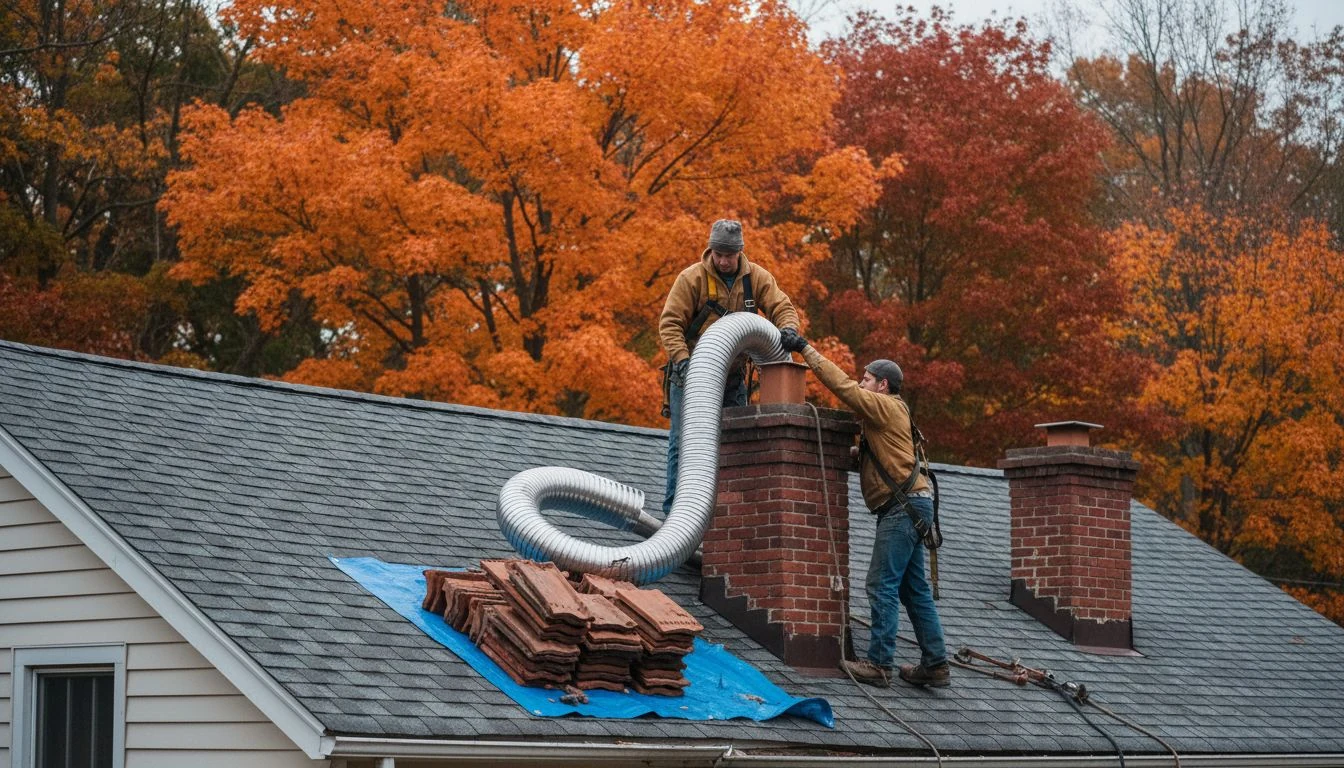
Last winter I sat in front of our open fireplace with a blanket on my lap and watched the thermostat in the hallway click the furnace on. The fire was roaring. The furnace ran anyway. Most of that heat was going straight up the chimney, along with the warm air from the rest of the house.
This year I priced a wood-burning insert, and the insert sent me down a road I didn’t expect: the stove itself was the easy part. The liner was the part that tripled the conversation.
The chimney liner cost in 2026, short version: a stainless steel liner, installed in a typical one- or two-story chimney, usually runs about $2,500 to $5,000, and more with insulation or a tall or crooked flue. A cast-in-place liner runs about $4,000 to $10,000. Replacing clay tile is the priciest and messiest, often $5,000 to $10,000 or more, because someone has to open up the masonry. A smaller aluminum liner for a gas water heater can be $1,000 to $2,500.
Below: the liner types side by side, my written quotes for the insert, the lines that move the price, and the part of this job I’d never touch from a ladder.
Jump to what you need:
- Chimney liner cost in 2026
- Stainless, clay or cast-in-place
- My three chimney liner quotes
- When you actually need a new liner
- The line items that move the price
- What you can do yourself
- Chimney liner cost by type
- Frequently Asked Questions
Chimney liner cost in 2026: the short version
A chimney liner is the tube inside the masonry that the smoke and gases actually travel through. In older houses it’s usually square or rectangular clay tile, stacked and mortared as the chimney was built. The brick around it is the shell. The liner is what keeps heat away from the wood framing in your walls and keeps acidic smoke from eating the mortar.
When a liner is cracked, missing, or the wrong size for what you’re burning, you have three ways to fix it, and they cost very different amounts:
- Stainless steel, rigid or flexible, slid down from the top: about $2,500 to $5,000 installed for most houses, roughly $65 to $150 per foot all in.
- Cast-in-place, where a crew pours a cement-like mix around a form inside the old flue: about $4,000 to $10,000.
- New clay tile, which usually means opening the chimney from the side or rebuilding part of it: $5,000 to $10,000 and up.
Those are estimates from my own quotes, a neighbor’s invoice and what three sweeps told me on the phone. They swing a lot by region, by chimney height and by how hard your roof is to stand on.
Stainless, clay or cast-in-place: chimney liner types compared
I went into this thinking a liner was a liner. It isn’t. Each type fits a different situation, and the sweep who only sells one type will tell you it fits yours.
Stainless steel. This is what almost everyone gets now, and what all three of my quotes started with. A flexible stainless liner comes on a big coil and gets fed down the flue from the roof, then connected to a top plate and a cap. Rigid stainless is straight sections, cheaper per foot but only works in a chimney that runs straight. For wood, the better installers use a heavier grade and wrap it in insulation. For gas, a lighter stainless or aluminum liner is common and cheaper.
Cast-in-place. A crew lowers an inflatable form down the flue and pours a lightweight insulating mix around it. Once it sets, they pull the form out. What’s left is a smooth, round flue that also adds some strength to old masonry. It costs more and takes longer, but for an old chimney with crumbling inner mortar, it’s the one option that fixes the structure at the same time.
Clay tile. Cheap as a material, expensive to replace. Getting broken tiles out and new ones in usually means cutting into the side of the chimney or taking the top down. It makes sense when a chimney is being rebuilt anyway. As a repair on its own, it’s rarely the best deal.
There’s also a fourth option nobody mentioned until I asked: resurfacing. If the clay tiles are mostly sound with gaps in the mortar joints or small cracks, some sweeps spray or brush a heat-resistant ceramic coating inside. That ran about $1,000 to $3,000 in the two prices I heard. It does not work for a liner that’s badly broken or the wrong size.
My three chimney liner quotes for a wood insert
Some backstory. When I bought this house, a Level 2 camera inspection showed the clay liner was intact, no cracks anywhere. I wrote about that whole adventure, including the cash-only guy who tried to sell me a $4,800 liner I didn’t need, in our chimney inspection cost guide.
The reason for a liner now was the insert. The installation manual for the one I picked called for a full-length liner sized to its 6-inch outlet, running from the insert all the way to the top. Our clay flue is about 8 by 12 inches inside. Too big. Smoke from a modern insert cools in a huge flue, drafts poorly and leaves more creosote. My chimney was fine for an open fireplace and wrong for the stove I wanted to put in it.
Three quotes, same week in September, same chimney: about 26 feet from the hearth to the top.
Quote 1: $6,900. A cast-in-place liner, “the last liner you’ll ever buy.” He spent most of the visit talking about a lifetime warranty and very little looking at the chimney. Cast-in-place is a real product. But my tiles were fine and the insert maker wanted a 6-inch round flue connected to the insert, which a stainless liner does more simply. He was selling what he had.
Quote 2: $3,100. A flexible stainless liner, no insulation, and the quote was three lines long. When I asked about the top plate, the cap and the connection to the insert, he said “that’s all standard” but wouldn’t write it down. He also said insulation was “a waste of money.” The insert manual disagreed with him about the clearance it needed, and so did the next installer.
Quote 3: $4,250. A 6-inch insulated stainless liner, 26 feet plus the connector, a top plate sealed to the crown, a new stainless cap, a final camera run so I could see the finished install, and the permit. She asked what insert model I had, looked up its manual on her phone while standing in my living room, and pointed at the line about the liner size. Her quote listed every part.
I went with Quote 3. The insert itself was a separate purchase and install, which I’ll write up once I’ve burned through a winter with it. If your quotes look nothing alike, the way mine didn’t, our guide on how to tell if a contractor quote is fair shows how I lay them side by side.
When you actually need a new chimney liner
This is where the scams live. A liner is invisible from the living room, so a sweep can say almost anything about it. These are the situations where a new liner is a real need, not a sales pitch:
- A camera inspection shows cracked, shifted or missing tiles, and you’ve seen the footage yourself.
- There’s been a chimney fire. The Chimney Safety Institute of America lists cracked or collapsed flue tiles, or tiles with big chunks missing among the signs of one, and says a factory-built metal chimney damaged by a fire should not be used and must be replaced.
- You’re installing an insert or a stove whose manual calls for a liner of a certain size. That was me.
- A gas furnace was replaced with a high-efficiency model that vents out the side wall, leaving a gas water heater alone in a big old flue.
- There’s no liner at all, which happens in some very old houses.
That fourth one caught my neighbor. Two winters ago she put in a new high-efficiency furnace that vents through a white plastic pipe out the side of the house. Nobody mentioned that her water heater, which still vented into the brick chimney, was now the only thing using a flue sized for a furnace and a water heater together. The sweep who came in the spring found rust flakes and moisture at the bottom. She paid about $1,400 for an aluminum liner sized for the water heater. If you’re pricing a furnace swap, ask about this up front. Our furnace replacement cost guide has the other lines that show up on those quotes.
What does not, on its own, mean you need a liner: some soot, a smell in summer, a little white stain on the outside brick, or a flyer that says “free chimney inspection.” Ask to see the video.
The line items that move the chimney liner cost
Two quotes for “a stainless liner” can be $2,000 apart. The difference is almost always in these lines, so read every quote for them.
- Height. Most liners are priced by the foot. A two-story chimney with a tall stack above the roof can need 35 feet or more, and the cost climbs with it.
- Insulation. A wrap or a poured insulation mix around the liner can add $500 to $1,500. For wood-burning inserts and stoves, it’s often what makes the clearances work. Ask what the appliance manual requires before anyone talks you out of it.
- Offsets. A chimney that jogs sideways partway up needs a flexible liner, and sometimes a crew has to break a few tiles to get it past the bend. That can add a few hundred dollars.
- Removing old tile. If the old flue is too tight for the new liner, the crew may have to break out the clay tiles first. I heard $500 to $1,500 for that.
- Top plate, cap and crown. A new liner needs a sealed top plate and a cap. If your crown is cracked, fixing it now is cheaper than a separate trip later.
- Roof access. Steep roofs, slate or tile roofing and three-story chimneys mean more safety gear and more time.
- Permit and final inspection. Many towns want a permit for a new liner or a new stove. Expect $50 to $300 for the permit.
One more thing to watch. The cheapest stainless quotes sometimes use a thinner liner that’s fine for gas but not meant for wood. Ask the grade and the thickness, and ask whether it’s rated for the fuel you burn. If the installer won’t put that in writing, that tells you something too.
What you can do yourself, and what stays on the roof
You can buy stainless liner kits online for about $800 to $2,000. I looked at them for exactly one evening.
Then I pictured myself on a 10/12-pitch roof, in October, holding one end of a 26-foot coil of steel while my husband pushed from below. A liner install means working on a roof edge with a heavy, springy coil and a chimney opening you can’t see into. And getting the insulation, connector and clearances wrong doesn’t show up as a leak. It shows up as heat on wood framing that you can’t see. That’s not a job where I want to be the one who learns.
What I did do, and what you can too:
- Got the appliance manual before calling anyone, and highlighted the liner size and clearance pages.
- Measured the height from the hearth to the top of the chimney, roughly, with a long tape from the yard and a photo. It made comparing quotes per foot much easier.
- Booked the sweep and liner for early fall, before the first cold week. Every sweep I called in October was booked into November.
- Bought dry firewood. Wet wood makes more creosote, and creosote is what a new liner is protecting you from. The EPA’s Burn Wise program has instructions on seasoning firewood and a list of EPA-certified wood stoves and inserts, which I used when picking mine.
- Put a yearly sweep on the calendar. Our chimney sweep cost guide covers what that runs once the chimney is in good shape.
Ask every chimney liner installer these before you sign. Can I see the camera footage of my current liner. What liner type, grade and thickness are you quoting, and is it rated for wood, gas or oil. What diameter, and does it match my appliance manual. How many feet are included. Is insulation included, and is it required for my clearances. Are the top plate, cap and connection to the appliance included. Will you need to remove the old tile, and what does that cost. Is the crown in good enough shape to seal to. Is the permit included. Will you send a camera down after the install so I can see it. What is the warranty on parts, and separately on labor. Get every answer in writing.
Chimney liner cost by type and job
I built this from my three quotes, my neighbor’s invoice and the prices I heard on the phone from three other sweeps. Use it to read your own quotes, not as a price list.
| Liner job | Best fit | Installed cost (2026 estimate) | What pushes it higher |
|---|---|---|---|
| Aluminum or light stainless, gas | Gas water heater or furnace in an oversized flue | $1,000 – $2,500 | Tall chimney, two appliances |
| Flexible stainless, wood, uninsulated | Straight chimney where clearances already work | $2,500 – $4,000 | Offsets, roof pitch |
| Flexible stainless, wood, insulated | Wood insert or stove in an older chimney | $3,500 – $6,000 | Old tile removal, 30+ feet |
| Rigid stainless | Straight flue with no bends | $2,500 – $5,000 | Height, crown repair |
| Cast-in-place | Old masonry with failing inner mortar | $4,000 – $10,000 | Multiple flues, structural repairs |
| Clay tile replacement | Chimney being rebuilt anyway | $5,000 – $10,000+ | Opening the masonry, rebuilding the top |
| Ceramic resurfacing | Sound tiles with gaps or small cracks | $1,000 – $3,000 | Length of flue, prep cleaning |
What blows the chimney liner budget
- Buying a liner you never saw a reason for. No camera footage, no liner. Get a second inspection before you spend four figures.
- Picking the appliance after the liner. The liner diameter has to match the stove or insert outlet. Choose the appliance first and hand the installer its manual.
- Skipping insulation to save a few hundred. If the appliance needs it for clearances, leaving it out can mean redoing the job or failing the permit inspection.
If the chimney work is part of a bigger winter list, our guide to winterizing a house covers the cheaper jobs to finish first. And if you’re weighing this against other projects, the overview of home renovation costs puts it in context.
The liner went in the second week of September. I watched the camera footage on the installer’s tablet while standing in the driveway: a shiny round tube all the way up, with the cap on top. The insert is in now too. Last Tuesday it was 41 degrees out at seven in the morning, the fire was going, and the hallway thermostat never clicked once.
Frequently Asked Questions
How much does it cost to reline a chimney?
Relining a chimney with stainless steel usually costs about $2,500 to $5,000 installed in 2026, and more with insulation, a tall chimney or tile removal. Cast-in-place relining runs about $4,000 to $10,000. These are estimates and vary by region and chimney height.
How do I know if my chimney liner is damaged?
You usually can’t tell from inside the house. A Level 2 inspection with a camera shows the whole flue. Ask to see the footage. Pieces of tile in the firebox, or a past chimney fire, are reasons to get it checked before the next fire.
Do I need a new liner for a wood stove insert?
Often, yes. Many insert manuals call for a full-length liner sized to the insert outlet, because an oversized clay flue drafts poorly and builds creosote faster. Check your insert’s manual and follow it.
All prices here are 2026 estimates from my own written quotes, a neighbor’s invoice and what chimney sweeps told me, and they vary by region, chimney height, liner type and roof access. Tessa is a hands-on homeowner, not a certified chimney sweep or licensed contractor. Liner installs, appliance connections and anything on the roof should be handled by a certified professional, and your appliance manual and local code always come first.
Free DIY Project Cost Estimator
The spreadsheet I use to price out a project before I start, so a weekend job never blows the budget. Join the newsletter and I’ll send it over.
No spam, ever. Unsubscribe anytime. — Tessa
Keep reading — more on Remodel & Renovation Costs
Whole House Humidifier Installation Cost (and Whether You Need One)
Last January the little hygrometer on my bookshelf read 21 percent. I’d bought it for $14…
Read article →
Gas Fireplace Installation Cost: Inserts, Built-Ins, and Venting
My sister Jen has a brick fireplace in her 1962 ranch that she has used exactly…
Read article →
Shower Remodel Cost: Refresh, Walk-In, and Full Tear-Out
My mom called me in August because the floor of her shower had started to flex.…
Read article →
Gas Line Installation Cost: For a Stove, Dryer, Fireplace, or Generator
For nine days last winter, a brand new gas range sat in the middle of our…
Read article →