
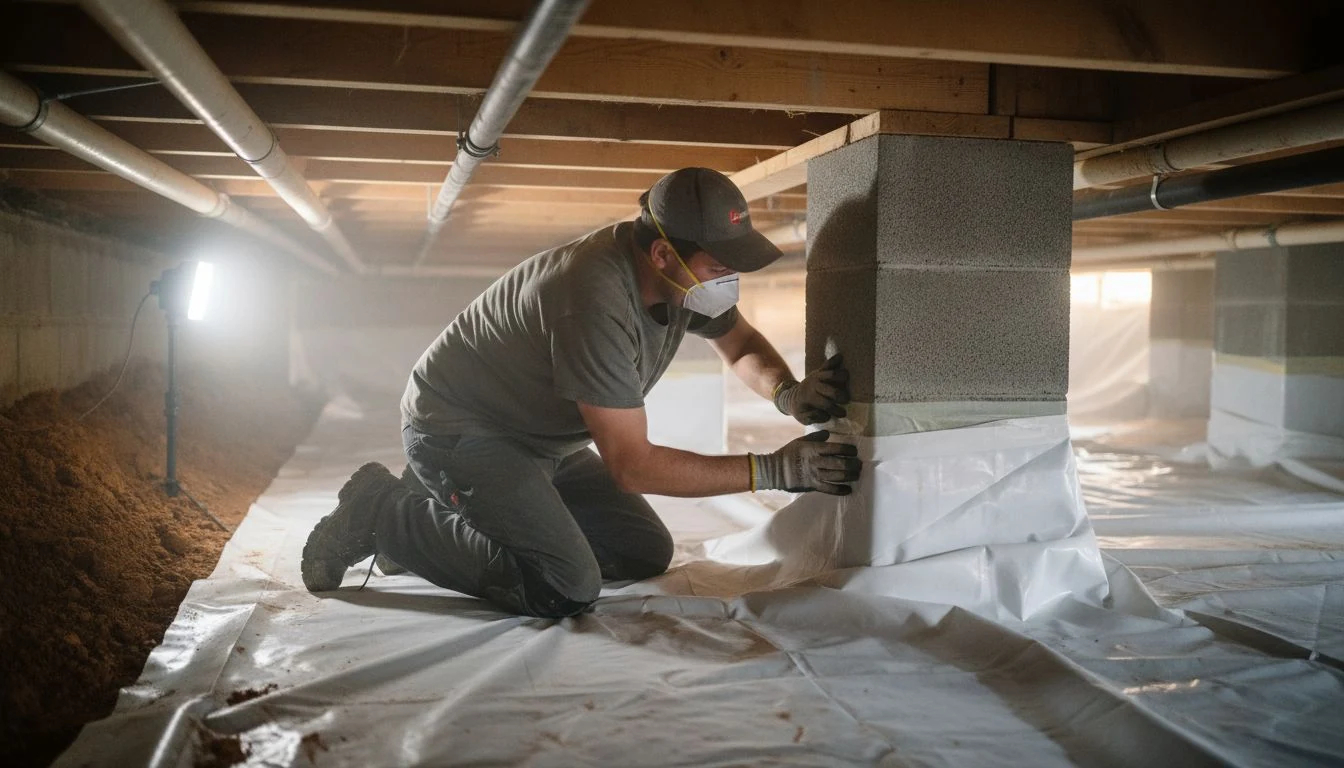
The first contractor who went under my house came back up in about four minutes, sat on the edge of the hatch, and said one word: “Yeah.” Then he showed me his phone. The photo was a dirt floor, a sheet of plastic torn in three places, and standing water pooled on top of it.
He quoted me $9,400. The next guy quoted $4,100 for what he described as the same job. That gap is the reason this post exists.
The honest answer is that crawl space encapsulation cost runs about $3,000 to $8,000 for a typical 1,200 square foot crawl space in 2026, with the national spread landing somewhere between $1,500 and $15,000 depending on what is wrong down there before anybody rolls out a single foot of liner. Priced by area, most quotes land between $3 and $7 per square foot.
But the number is not the interesting part. The interesting part is that a lot of houses do not need this at all, and the companies selling it are not the ones who will tell you that. I got three quotes, bought a $15 hygrometer, and ended up spending less than the cheapest bid. Here is what I learned, including the part where I almost paid for a system my house did not need.
Jump to what you need:
- Crawl space encapsulation cost in 2026, line by line
- Why a dirt floor makes the whole house damp
- What drives the crawl space encapsulation cost up
- The dehumidifier nobody puts in the first quote
- When you do not need encapsulation at all
- Doing it yourself, and where that stops being smart
- Crawl space encapsulation cost by scope
- Frequently Asked Questions
Crawl space encapsulation cost in 2026, line by line
Encapsulation is not one product. It is four or five separate jobs that companies bundle into a single number, which is exactly why two quotes for “the same thing” can differ by $5,000. Ask for the line items and the fog clears fast.
| Line item | Typical 2026 range | What it actually is |
|---|---|---|
| Cleanout and debris removal | $300 – $1,200 | Old torn plastic, construction trash, fallen insulation |
| Grading and drainage under the house | $800 – $3,000 | Only if water actually enters, not standard |
| Sump pump and basin | $900 – $2,500 | Only where the water table is high |
| Liner, 12 to 20 mil, sealed to walls and piers | $1,500 – $4,500 | The actual encapsulation |
| Wall insulation, rigid foam | $1,200 – $3,000 | Needed once you close the vents |
| Vent sealing and access door | $300 – $900 | Small, and skipping it undoes the rest |
| Dedicated dehumidifier, installed | $1,300 – $2,600 | The line item quotes hide |
My $9,400 bid and my $4,100 bid were both honest, it turned out. The expensive one included drainage, a sump and a dehumidifier. The cheap one was liner and vents. Neither salesman volunteered which of those my house actually needed, and that was the one thing I was trying to buy.
Why a dirt floor makes the whole house damp
This is the part I did not understand during the first two quotes, and understanding it is what let me push back on the third.
The EPA lays out the mechanism in its guidance on why and where mold grows, and it describes a crawl space almost exactly like mine: crawl spaces with high relative humidity are common sites of hidden mold growth, “particularly if the crawl space has a bare earth floor.” The soil wicks moisture through capillary action from wet areas toward dry ones, the relative warmth of the crawl space evaporates it, and that water goes straight into the air under your house.
Then it does not stay there. The EPA is direct about the next step: moisture that accumulates in a crawl space “may also enter another part of the building” through cracks in walls, floors and ceilings. Warm air rises and pulls crawl space air up with it. The damp smell in a first-floor closet in August started life as dirt.
Before you accept any encapsulation quote, get these four answers in writing. Does water actually enter the crawl space, or is it only humidity? What is the relative humidity reading down there today, and what will it be after the work? Is a dehumidifier included or extra? And is the liner sealed to the walls and piers, or just laid on the ground? A company that will not put those in writing is selling you a liner, not a solution.
The EPA also lists what feeds the problem from outside, and one item on that list is the cheapest thing on this entire page: “landscaping, gutters and down spouts that direct water into or under a building.” Before you spend $6,000 under the house, spend a Saturday making sure the water outside is going away from it. My downspout was dumping four feet from the foundation wall, which I had walked past roughly nine hundred times without seeing. Extending it cost $22. If the gutters themselves are the problem, my gutter installation cost guide has those numbers.
What drives the crawl space encapsulation cost up
Five things move the price, and only one of them is square footage.
Headroom. A crawl space with 18 inches of clearance costs more to work in than one with 36. Everything happens on someone’s back, and labor is most of this bill.
Standing water. Humidity is a liner problem. Water is a drainage problem, and drainage is where quotes double. A contractor who sees water and still quotes liner only is either not looking or hoping you are not.
What is already down there. Hauling out sixty pounds of fallen fiberglass, dead ductwork and somebody’s 1978 plastic sheeting is billable hours before the real job starts.
Liner thickness. Twelve mil is the common floor. Twenty mil costs more and survives being crawled over by every plumber and HVAC tech for the next twenty years. I went thicker and I would again.
Whether the vents get closed. Sealing the vents turns the crawl space into part of the house, so the walls need insulation and the space needs a way to stay dry. That is not an upsell. It is the trade-off that comes with closing the vents, and it is where the total jumps.
The dehumidifier nobody puts in the first quote
Seal a crawl space, close the vents, and you have built a small sealed room under your house. Sealed rooms with soil and concrete around them do not dry themselves.
A dedicated crawl space dehumidifier runs about $1,300 to $2,600 installed in 2026, and it is the single most common line item to appear in revision two of a quote, after you have signed revision one. Ask about it on day one. If a company tells you the liner alone will hold humidity under 60 percent, ask them to write that number into the contract with a follow-up reading at 90 days.
Mine sits at 52 percent now. It read 74 in July, before any of this. The dehumidifier costs me roughly $12 a month in electricity, which is the cheapest part of the whole project.
When you do not need encapsulation at all
Here is the section the contractor will not write for you.
If you live in a genuinely dry climate, your crawl space is vented, the relative humidity down there reads under 55 percent in the worst week of summer, and there is no standing water and no musty smell upstairs, then encapsulation is a $6,000 answer to a question your house never asked. Buy a $15 hygrometer, leave it under the house for two weeks during your most humid month, and read it before you sign anything. That is the whole diagnostic, and it is the one nobody offering a free inspection will suggest.
I also watched a neighbor spend $7,200 encapsulating a crawl space whose real problem was a slow supply line leak. The liner sealed the moisture in against the wood. Fix the water source first, always. A leak is a plumbing bill, not a $7,000 system, and my guide to fixing a leaky outdoor faucet covers the version most people can handle in an afternoon.
The other honest exception: if your floor joists are already sagging or the piers have shifted, encapsulation is cosmetic. That is structural work and it comes first. My foundation repair cost guide has those ranges, and they are a different order of magnitude.
Doing it yourself, and where that stops being smart
Materials for a 1,200 square foot crawl space come to roughly $900 to $1,800: liner, seam tape, mechanical fasteners, butyl for the wall termination, and foam board if you are closing vents. So the saving is real. It is also the hardest physical work I have done on this house.
ENERGY STAR calls basement and crawlspace air sealing and insulating “generally considered moderate to difficult do-it-yourself (DIY) projects” in its guidance on sealing and insulating those spaces, and I would call that generous. You are dragging 200 pounds of plastic through 20 inches of clearance, on your elbows, in the dark, in a space you cannot sit up in.
My line: I will do liner and vent sealing myself in a crawl space with decent headroom and a dry floor. I will not do drainage, a sump, or anything involving electrical for a dehumidifier. And if there is any chance of asbestos in old duct wrap or vermiculite insulation down there, nobody in my family goes under the house until it has been tested.
If you are hiring out, get three quotes and make them itemize. The pattern for reading them is the one I use for every trade, and I wrote it up in how to tell if a contractor quote is fair. For where this sits against every other project in the house, the whole picture is in my home renovation cost guide.
Crawl space encapsulation cost by scope
Three tiers, because the word “encapsulation” gets used for all of them and only one is what most companies mean when they quote you.
| Scope | 2026 estimate | What you get | Right for |
|---|---|---|---|
| Vapor barrier only | $1,200 – $3,000 | Liner on the ground, taped seams, vents stay open | Dry climates, mild humidity, tight budget |
| Full encapsulation | $3,500 – $8,000 | Liner sealed up the walls, vents closed, wall insulation, dehumidifier | Humid climates, musty house, high summer readings |
| Encapsulation plus water management | $7,000 – $15,000 | All of the above plus interior drain and sump pump | Actual standing water or a high water table |
| DIY liner and vent seal | $900 – $1,800 in materials | Your weekends and your back | Good headroom, dry floor, no electrical work |
What blows the encapsulation budget
- Buying the system before diagnosing the water. Drainage, a sump and a dehumidifier are the three line items that turn a $4,000 job into a $12,000 one, and a house with only a humidity problem needs none of them. Two weeks with a hygrometer costs $15 and tells you which quote is honest.
- Closing the vents without insulating the walls. Sealing a crawl space and skipping the wall insulation leaves a cold sealed box under a heated house, and you pay for that in the heating bill every winter instead of once at signing.
- Free inspections from companies that only sell encapsulation. I took three, and all three found that my house needed encapsulation. The one useful opinion cost me $250 from an independent home inspector with no system to sell, and it is why I skipped the drainage package.
A damp crawl space is also where termites like to start, and the inspection that finds one often finds the other, which is why I wrote up what a termite inspection costs and what treatment runs after it.
If the water under the house is coming in faster than the vapor barrier can handle, a pump usually ends up in the plan too, and I priced mine out in what a sump pump replacement costs.
An open, damp crawl space is also where mice like to nest once the nights get cold. Before you pay for trapping, read my three mouse exterminator quotes.
Frequently Asked Questions
How much does crawl space encapsulation cost?
Budget $3,000 to $8,000 for a typical 1,200 square foot crawl space in 2026, or roughly $3 to $7 per square foot. A vapor barrier alone runs $1,200 to $3,000, and adding interior drainage with a sump pump can push the total past $12,000. These are estimates, and they move a lot with your region, your water table, and how much headroom the crew has to work in.
Is crawl space encapsulation worth it?
It is worth it if your crawl space has a bare earth floor, high summer humidity, or a musty smell reaching the living space, because you are cutting off a moisture source for the whole house instead of treating symptoms upstairs. It is not worth it in a dry climate with a vented crawl space reading under 55 percent relative humidity and no water intrusion. Measure first with a cheap hygrometer over two weeks in your most humid month.
Can you do crawl space encapsulation yourself?
You can do the liner and the vent sealing yourself for roughly $900 to $1,800 in materials, and plenty of homeowners do. ENERGY STAR classes this kind of work as a moderate to difficult DIY project, which is fair: it is hours of crawling in low clearance. Leave drainage, sump pumps, dehumidifier wiring, and any suspected asbestos or vermiculite to a professional.
Does encapsulation stop mold?
It removes the moisture that mold needs, which is the actual lever. The EPA notes that mold grows on virtually any organic material as long as moisture and oxygen are present, so cutting off ground moisture and holding humidity down is what changes the conditions under your house. Existing growth is a separate remediation job with its own cost, and health questions about mold belong to the EPA guidance and a qualified professional, not to a cost guide.
If your crawl space is really a basement question, or you are weighing whether to make that space usable rather than just dry, the numbers are in my cost to finish a basement guide and my breakdown of what basement contractors charge. If the ductwork under there is part of why the house never feels right, furnace repair costs are the other half of that conversation. And before the first freeze, the crawl space shows up again on my winterizing checklist.
All prices here are 2026 estimates and vary by region, climate zone, crawl space size and headroom, water table, existing damage, and local trade rates. Tessa is a hands-on homeowner who has hired this work and read the quotes, not a licensed contractor, structural engineer, or mold remediation professional. Nothing here is an inspection of your house. Structural movement, suspected asbestos or vermiculite, electrical work, and existing mold growth belong to licensed professionals. For health questions about mold, use the EPA guidance linked above and speak to a professional. Use these ranges to ask sharper questions of the people bidding on your house, not as a quote.
Free DIY Project Cost Estimator
The spreadsheet I use to price out a project before I start, so a weekend job never blows the budget. Join the newsletter and I’ll send it over.
No spam, ever. Unsubscribe anytime. — Tessa
Keep reading — more on Remodel & Renovation Costs
Whole House Humidifier Installation Cost (and Whether You Need One)
Last January the little hygrometer on my bookshelf read 21 percent. I’d bought it for $14…
Read article →
Gas Fireplace Installation Cost: Inserts, Built-Ins, and Venting
My sister Jen has a brick fireplace in her 1962 ranch that she has used exactly…
Read article →
Shower Remodel Cost: Refresh, Walk-In, and Full Tear-Out
My mom called me in August because the floor of her shower had started to flex.…
Read article →
Gas Line Installation Cost: For a Stove, Dryer, Fireplace, or Generator
For nine days last winter, a brand new gas range sat in the middle of our…
Read article →