
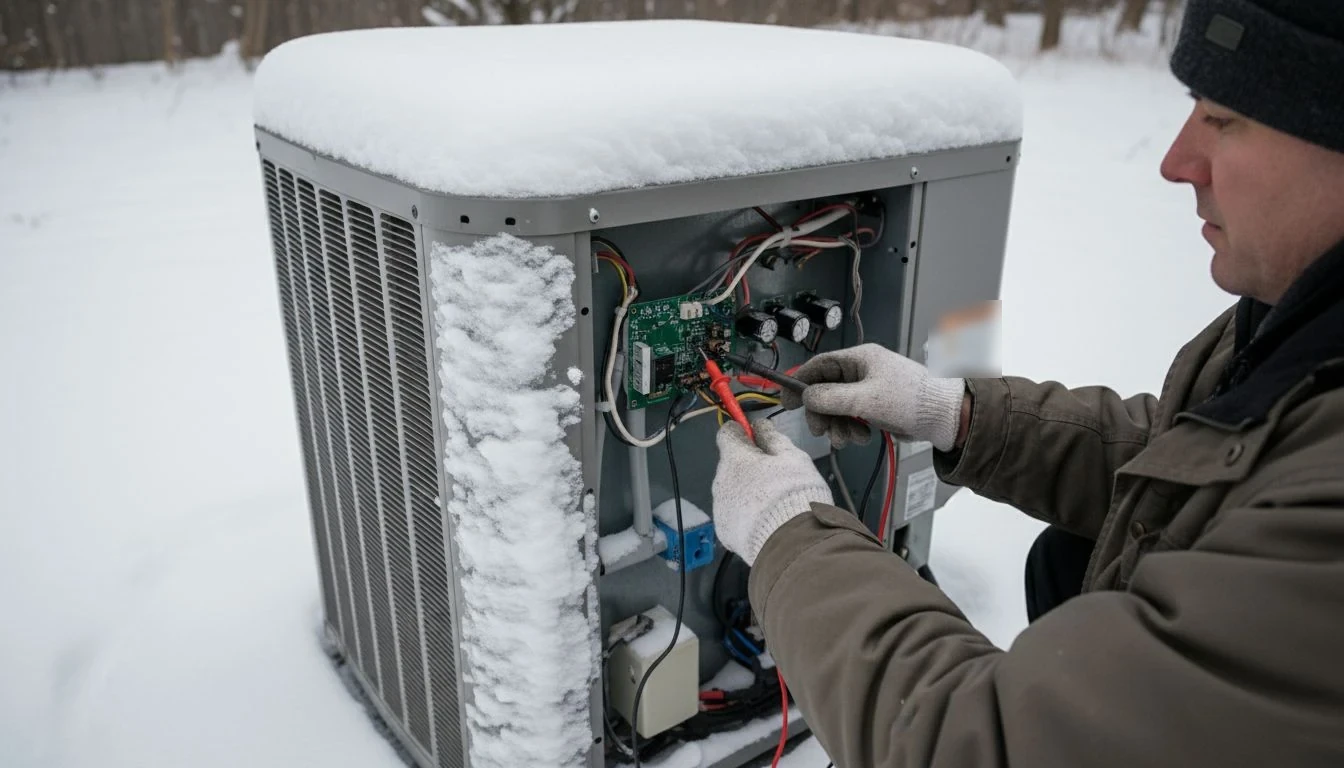
It was 14 degrees on a Sunday morning in February, and the outdoor unit at the house before this one looked like somebody had packed it in a snow cone. A solid shell of ice over the coil. The fan was still turning inside it, scraping, and the thermostat said AUX HEAT in little orange letters I had never noticed before.
The first company quoted a $1,900 reversing valve, then a whole new system at $11,400. The second found a dead defrost board: $620, and four more winters.
Heat pump repair cost in 2026 runs about $150 to $650 for the failures most houses actually get, $700 to $2,500 once you are into motors, valves and refrigerant leaks, and $1,500 to $4,500 for a compressor. Below is what each part costs, the winter problem that gets misdiagnosed constantly, the refrigerant line a salesperson may use on you, and the point where replacing beats repairing.
I am a homeowner who keeps every invoice, not a licensed HVAC technician. Everything with refrigerant in it is a job for one.
Jump to what you need:
- Heat pump repair cost in 2026
- The diagnostic visit
- Cost by the part that failed
- The winter ice problem
- Refrigerant, and the 2025 rule change
- What I check before I call
- When to replace instead
- Cost by symptom
- Frequently Asked Questions
Heat pump repair cost in 2026, the short version
Most heat pump repair bills I see from friends, neighbors and my own folder land between $150 and $650. That covers the common stuff: a capacitor, a contactor, a defrost sensor or board, a drain line, a thermostat that lost its mind.
The four figure bills come from a short list. Reversing valves, blower motors, refrigerant leaks that need a coil, and compressors. Those are real, and they happen, but they are the minority of calls. They just get quoted like they are the default.
A heat pump also works harder than the machines it replaces. It heats in winter and cools in summer, so it racks up hours in both seasons instead of one. That is why a 12 year old heat pump is older, mechanically, than a 12 year old furnace sitting in the basement doing nothing from May to October. Keep that in mind when you read the replacement section.
My own line: a first quote over $1,500 on a unit under 10 years old gets a second opinion before anyone touches it.
What the diagnostic visit costs before anyone opens a panel
Expect $100 to $250 for a standard service call in 2026. Nights, weekends and holidays commonly run $200 to $400. Mine was on a Sunday at 14 degrees, which is the worst possible combination, and the first company charged $189 just to walk to the side of the house.
Two things to ask on the phone before they come out:
- Does the diagnostic fee get credited toward the repair if I approve it today?
- Is the fee flat, or does the clock start when the truck leaves the shop?
Most local companies credit the fee. Some do not, and you want to know that before the truck is in your driveway. If you are on a maintenance plan, check the paperwork, because a lot of plans waive the diagnostic and knock 10 to 15 percent off parts.
One thing I learned the expensive way: a diagnostic that ends with “you need a new system” and no named failed part is not a diagnosis. Ask which component failed and how they tested it. A good tech will tell you what the meter read. The one who sold me an $11,400 system could not.
Heat pump repair cost by the part that failed
These are installed prices, parts plus labor, for a typical residential split system. The same part on a variable speed unit usually costs more, sometimes a lot more.
- Run or dual capacitor: $150 to $450. The most common summer failure by a mile. We have a full breakdown in our AC capacitor replacement cost guide, and a heat pump uses the same part.
- Contactor: $150 to $400. Often replaced alongside the capacitor.
- Defrost control board: $300 to $750. Mine was $620 with the diagnostic.
- Defrost sensor or thermostat: $150 to $350.
- Thermostat replacement: $150 to $500, more for a smart model the installer programs.
- Outdoor fan motor: $350 to $850.
- Indoor blower motor: $450 to $1,500. Variable speed ECM motors sit at the top of that.
- Backup heat strip or sequencer: $200 to $700.
- Condensate drain clog or pump: $100 to $350.
- Reversing valve: $1,000 to $2,500. Lots of labor, plus the refrigerant has to come out and go back in.
- Refrigerant leak search and repair: $250 to $1,500, plus the recharge.
- Indoor or outdoor coil: $1,200 to $3,000.
- Compressor: $1,500 to $4,500. Our compressor replacement guide covers the warranty angle, which is where this number can drop hard.
Look at where the reversing valve sits. It is the part that flips the machine from cooling to heating, and it is the one I was quoted first. It does fail. It also gets blamed for problems that live on a $300 circuit board, because both of them can leave you with a unit that will not heat properly.
If the capacitor, contactor and drain line look familiar, that is because they are the same parts that fail on a central air conditioner. Our AC repair cost post goes deeper on those, and the prices carry over almost exactly.
The winter ice problem that gets misdiagnosed
I wish I had known this part that Sunday.
A heat pump pulls heat out of cold outdoor air, and in winter the outdoor coil gets colder than the air around it. Frost forms. So every so often the unit runs a defrost cycle: the fan stops, the machine briefly switches into cooling mode to warm the coil, and you may see a cloud of steam roll off it and hear a loud whoosh. The first time I saw that at night I thought it was on fire.
That is normal. A light frost that comes and goes is normal too.
What is not normal is a solid block of ice that stays for hours, covers the top of the unit, or keeps growing. That means defrost is not happening. The usual suspects, in rough order of how often I have heard of them:
- The defrost board or its sensor failed. $150 to $750.
- The unit is low on refrigerant, so the coil runs colder than it should. Leak repair plus recharge.
- Airflow is choked, either a clogged filter inside or snow and leaves packed around the outdoor coil.
- Water from the roof is dripping straight onto the unit and refreezing. A gutter fix, not an HVAC fix.
- The reversing valve is stuck. Less common than it gets quoted.
Meanwhile, the house stays warm-ish because the backup heat strips kick in. That is the AUX HEAT light. Those strips are resistance heat, basically a giant toaster, and they cost a lot more to run than the heat pump does. My electric bill that February was about $140 higher than the January before it, entirely from the week I let the thing limp along before I called.
A frozen unit won’t hurt anyone, but it will hurt the bill, so call within a day or two. Do not chip at the ice with anything. You will bend the fins or puncture a line, and then you have bought a coil.
Refrigerant leaks, and the 2025 rule a salesperson may lean on
Refrigerant is the expensive, heavily regulated part of any heat pump repair, and it is where I see the most confusion.
First, the rule. Starting January 1, 2025, the EPA restricted new residential air conditioning and heat pump systems to refrigerants with a global warming potential under 700, which pushes new installs away from R-410A. The part that matters for your repair bill is in the footnotes of the EPA’s HFC restrictions table: components used to repair existing systems are not subject to these restrictions. Your 2016 R-410A heat pump is not illegal to fix.
I bring this up because the $11,400 quote came with a speech about my system being “obsolete” and parts “going away.” Parts for R-410A systems were still on the shelf at the supply house. The refrigerant itself has gotten more expensive, and a fair quote prices that in. That is the whole story.
Second, the leak. Refrigerant is not used up like fuel. If a heat pump is low, it leaked. A tech who tops it off every fall without finding the leak is selling you a subscription to the same problem. Ask three things:
- Where is the leak, and how did you find it?
- Can it be repaired, or is it in the coil?
- How many pounds are you adding, and what is the price per pound on this invoice?
That last one matters because refrigerant is billed by weight, and I have seen two invoices for the same job differ by several hundred dollars on the recharge line alone. Put the pound count in writing.
This part is a pro job. Anyone who services equipment that can release refrigerant has to hold an EPA Section 608 certification. That rule is the reason you cannot legally buy most refrigerant and do this yourself, and I’m glad it exists.
What I check myself before I call anybody
Every one of these has saved me a service call at least once, or saved a friend one. None of them involve opening the unit.
Start at the thermostat. Is it set to heat, not emergency heat, and is the setpoint actually above room temperature? After a battery swap or a power blip, some thermostats come back in a mode you did not pick. I have paid $129 to learn this once.
Then the breakers. A split heat pump has two: one for the outdoor unit and one for the indoor air handler, plus a disconnect box on the wall next to the outdoor unit. A tripped one looks almost the same as a live one. Flip it fully off, then on.
Pull the filter. Energy Star’s own maintenance checklist says to inspect filters monthly and notes that airflow problems can cut a system’s efficiency by up to 15 percent. A clogged filter can also be enough to freeze the coil in summer and starve the house of heat in winter.
Walk out to the outdoor unit. Snow drifted against it, leaves in the top grille, a tarp somebody threw over it in October. Clear a couple of feet around it with your hands or a soft broom. Keep the gutters above it working, because a steady drip onto the top of a heat pump in January is a frozen unit waiting to happen.
In cooling season, check the drain too: a full condensate pan or pump can shut the indoor unit off through a safety switch. If there is water around the air handler, that is where to look.
If all of that checks out and the house still won’t heat, call. Write down what you saw and when, including whether the AUX light was on. It saves the tech time, and time is what you are paying for.
The fall visit does more than any of this. The same Energy Star checklist recommends a pre-season check-up each year, heating in the fall, before contractors get slammed. Our heat pump maintenance guide breaks down what that visit should include and what it costs.
When to replace a heat pump instead of paying for another repair
I have nothing against a new heat pump. I object to being sold one on a Sunday morning while the house is at 61 degrees.
The rule of thumb a lot of techs use is the $5,000 rule: multiply the age of the unit by the repair cost. Over $5,000, start pricing replacement. A 13 year old unit with a $450 repair comes to $5,850, so you look. A 6 year old unit with a $900 repair is $5,400, and I would still fix that one, because a 6 year old compressor may still be under the manufacturer’s parts warranty.
I treat that as a tripwire. What decides it for me:
- Is this the compressor or a coil on a unit past about 12 years? That is the big one. Those repairs can run half the price of a new system on equipment near the end of its life.
- Is it the second major repair in two years? Two big bills in a row is the machine telling you something.
- Is the parts warranty still active? Registered units often carry 10 years on parts. That can turn a $3,800 compressor into a labor and refrigerant bill.
- Were you already unhappy with it? Loud, uneven rooms, big bills. Sometimes a repair keeps alive a system you never liked.
A replacement heat pump system commonly runs $6,000 to $15,000 installed in 2026, higher for cold climate models, variable speed units or new ductwork. If you are weighing a heat pump against a gas furnace for the replacement, our furnace replacement cost guide has that math, and furnace repair cost is the matching read if your heat pump is paired with a gas furnace as backup.
For the record, the house before this one got four more winters out of a $620 board. When we sold it, the unit was 15 years old and still running. The buyer’s inspector wrote “near end of service life” on the report, which was true and also fine.
Take this to every heat pump repair quote. Which part failed, by name, and how was it tested. Is the diagnostic fee credited toward the repair. Parts price and labor price, separately. Is the unit still under the manufacturer’s parts warranty, and did you check the serial number. If refrigerant is involved: where is the leak, is it repairable, how many pounds are being added and at what price per pound. What is the warranty on the repair labor. If you are recommending replacement, which component made that call, and what would the repair alone cost. Get it on paper, get a second quote on anything over $1,500, and compare line by line.
The FTC’s advice on avoiding home improvement scams applies here too: get more than one estimate, make sure the written one describes the work, the materials and the price, and do not automatically pick the lowest number. Our post on whether a contractor quote is fair walks through putting two bids side by side.
Heat pump repair cost by symptom, and what a fair quote looks like
This is the table I wish I had taped inside the utility closet. Start from what you are seeing, check the cheap cause first, and use the cost column to sanity check what you get quoted.
| What you notice | Most likely cause | Typical 2026 cost | Check yourself first |
|---|---|---|---|
| Outdoor fan not spinning, unit humming | Capacitor or fan motor | $150 – $850 | Outdoor breaker and disconnect |
| Nothing runs at all | Contactor, control board, thermostat, power | $150 – $750 | Both breakers, thermostat mode and batteries |
| Solid ice for hours, AUX HEAT on | Defrost board or sensor, low refrigerant | $150 – $1,500 | Filter, snow and leaves around the unit, roof drip |
| Blows cool air in heat mode | Reversing valve, defrost stuck, low charge | $300 – $2,500 | Wait out a normal defrost cycle, about 10 minutes |
| Weak airflow from vents | Blower motor, dirty coil, clogged filter | $0 – $1,500 | Filter, closed or blocked vents |
| Water around the indoor unit | Clogged condensate drain or pump | $100 – $350 | Drain pan and the line outside |
| Hissing or bubbling, poor heating and cooling | Refrigerant leak | $500 – $3,000 with recharge | Nothing. Call a certified tech |
| Loud clunk at startup, breaker trips | Compressor or hard start issue | $300 – $4,500 | Note when it happens, do not keep resetting the breaker |
What blows the heat pump repair budget
- Letting it run on backup heat for a week. The repair might be $400, but the heat strips can add a hundred dollars or more to the electric bill while you wait. Call early.
- Recharging without finding the leak. Paying for refrigerant every fall adds up fast, and the leak usually grows. Pay once to find it, then decide.
- Skipping the warranty check. A registered unit under its parts warranty can turn a compressor or coil into mostly labor. Give the tech the serial number before you approve anything big.
If your heat pump repair turns into a bigger conversation about the whole house, our roundup of home renovation costs puts HVAC next to everything else competing for the same money.
Air handlers use the same kind of blower as a gas furnace, and the prices line up closely. Here is the blower motor replacement cost, PSC vs ECM.
Ductless heat pumps fail less often when the indoor head stays clean, and most of that work is a filter rinse every few weeks. Here is how I maintain our mini split and when I pay for a deep clean.
Frequently Asked Questions
How much does heat pump repair cost in 2026?
Most repairs land between $150 and $650, which covers capacitors, contactors, defrost boards and sensors, thermostats and drain problems. Blower motors, reversing valves and refrigerant leaks usually run $700 to $2,500, and a compressor runs $1,500 to $4,500. These are estimates, and the age of the unit, the warranty and your region move them a lot.
Is it normal for my heat pump to freeze up in winter?
Light frost that clears on its own is normal, and so is a defrost cycle where the fan stops and steam rolls off the unit. A thick block of ice that stays for hours, or covers the top of the unit, means defrost is not working. That is usually a board, a sensor, low refrigerant or blocked airflow. Clear snow and debris by hand, check the filter, and call if it does not clear.
Should I repair or replace a 15 year old heat pump?
For a small repair like a capacitor or contactor, repairing still makes sense. For a compressor, a coil or a second big repair in two years on a unit that old, start pricing a replacement. The age times repair cost rule, with $5,000 as the line, is a decent tripwire. Get the specific failed part in writing before you decide either way.
All prices here are 2026 estimates and vary by region, equipment type, refrigerant, warranty status and local labor rates. Tessa is a hands-on homeowner who has paid these invoices and kept the paperwork, not a licensed HVAC technician. Nothing here is repair instruction for refrigerant or electrical work. Use these ranges to ask sharper questions and read your own quotes, not as a price for your house.
Free DIY Project Cost Estimator
The spreadsheet I use to price out a project before I start, so a weekend job never blows the budget. Join the newsletter and I’ll send it over.
No spam, ever. Unsubscribe anytime. — Tessa
Keep reading — more on Remodel & Renovation Costs
Boiler Replacement Cost: Gas, Oil, and Combi Boilers Compared
My friend Marisol called me on a Sunday in October with her coat on inside the…
Read article →
HVAC System Replacement Cost: Furnace, AC, or Both at Once
The tech who told me my air conditioner was done also handed me a second price…
Read article →
Furnace Tune Up Cost: What a Fall Service Includes (and What to Skip)
Three companies left door hangers on my porch the same week in September. One said $79.…
Read article →
Furnace Blower Motor Replacement Cost in 2026: PSC vs ECM
My dad called on a Sunday in January and opened with “the furnace is running but…
Read article →